
When mixed strata demands thrust balance in TBM tunnel drives, new challenges arise. Jointed rock masses and layers of soft and hard sandstone can significantly impact the performance of tunnel boring machines. Achieving thrust balance is crucial for maintaining safety and efficiency during the tunneling process. CEGC offers a range of machines, including EPB and Slurry Shield types, designed to effectively handle these challenging conditions.
Key Takeaways
-
Thrust balance is very important for safe tunneling. It keeps the forces on the tunnel boring machine even. This stops the machine from tipping or shaking while it works.
-
Watching the cutterhead load and mud build-up in real time is key. This helps workers act fast if things change. It keeps thrust balance and stops damage to the machine.
-
Adaptive control systems can change machine settings by themselves. They do this based on the ground conditions. This keeps thrust balance and makes tunneling work better.
Thrust Balance Basics
Role in Tunnel Machine Operations
It is important to know about thrust balance to use tunnel boring machines safely. Thrust balance means the forces stay even as the machine moves forward. This helps the machine not tip or shake during digging. When using an EPB tunnel boring machine, you control the pressure inside the chamber. This pressure should be the same as the earth and water pressure outside the tunnel face. Keeping this balance stops the ground from sinking and keeps the tunnel safe.
Here are some key things about thrust balance in tunnel machine work:
-
Thrust balance helps the machine stay steady while digging.
-
The EPB method uses pressure to match outside forces.
-
You need to treat the soil and watch the process all the time.
-
Segmental lining holds up the tunnel as you dig.
-
Thrust force needs change with different types of ground.
Importance for TBM Tunnel Boring Machine Performance
Thrust balance is very important for how well tunnel boring machines work. You want every project to be efficient. If you know about torque and thrust forces, you can make tbm digging better and get good results. Thrust balance also keeps workers safe and stops the machine from breaking. You can tell when the machine needs fixing, which saves time and money.
The table below shows how different things change earth pressure and how well the machine works:
|
Parameter |
Effect on Earth Pressure |
|---|---|
|
Thrust |
Strongly affects |
|
Advance Speed |
Strongly affects |
|
Screw Conveyor Speed |
Insignificant impact |
|
Screw Conveyor Torque |
More significant impact |
You should think about total thrust and thrust force needs for each project. This helps you get the best work and results from your tunnel boring machines.
Mixed Strata Impacts on Thrust Balance
Ground Resistance Variability
When you use a tunnel boring machine in mixed strata, you face many problems. The ground can be soft in some places and hard in others. This makes the resistance at the cutterhead change a lot. Mixed strata demands thrust balance in tbm tunnel drives because each ground type pushes back differently. You have to change the thrust force to keep the machine safe and moving.
The table below shows how total thrust is different in each stratum:
|
Stratum Type |
Total Thrust Range (kN) |
|---|---|
|
Fine Sandstone Strata |
6518 ~ 8123 |
|
Medium-Coarse Sandstone Strata |
5560 ~ 8231 |
|
Fine Sandstone and Medium-Coarse Interbedded |
6242 ~ 8491 |
|
Shaly Sandstone Strata |
5504 ~ 6299 |
|
Shaly Sandstone and Coal Seam Interbedded |
3253 ~ 4308 |
|
Coal Seam |
3037 ~ 3767 |
Harder ground needs more thrust. Softer ground needs less. When you go from one layer to another, the thrust force changes fast. This makes it hard to keep the machine balanced. If you do not change the thrust, you could hurt the tunnel or the machine.
The chart below shows how thrust changes in different strata:
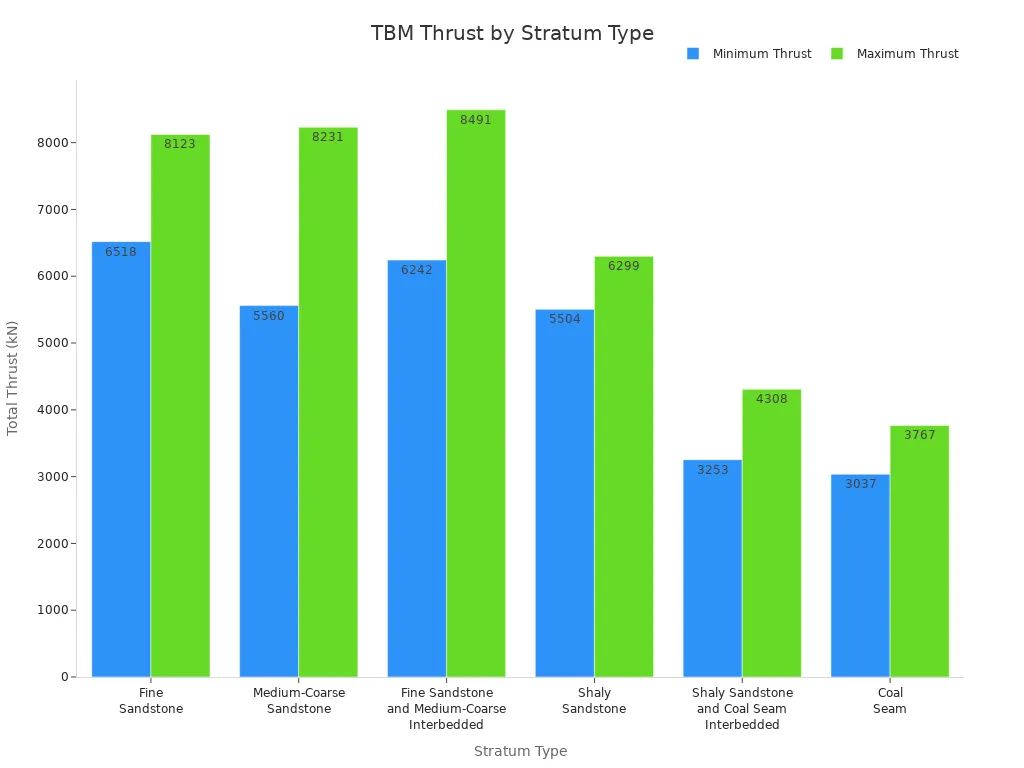
Mixed soil-rock and composite strata have different mechanical properties. This makes the way the cutterhead and ground work together more complicated. The thrust can change a lot, especially in composite strata. You need to watch the resistance closely and change the thrust to match the ground.
Cutterhead Load Distribution
Mixed strata demands thrust balance in tbm tunnel drives because the cutterhead gets different loads in each layer. The way the cutterhead and soil work together changes when you move from clay to rock or sand to composite layers. This changes the cutterhead load model and the cutterhead torque needed.
When you dig in composite strata, the load on the cutterhead is not even. Some parts of the cutterhead get more load than others. This uneven load can make some spots very stressed. If the stress is too high, the cutterhead can break. You need to watch the cutterhead load distribution to keep the machine safe.
Uneven cutterhead load distribution can:
Make some areas very stressed.
Push stress past safe levels.
Cause the cutterhead to break.
Make the cutterhead torque go up.
Lower your tunnel machine’s efficiency.
The cutterhead-soil interaction changes a lot in mixed strata. You should check the cutterhead load model and cutterhead torque often. If you see the load or torque go up fast, slow down or change how you dig. This helps keep the machine safe and working well.
Mud Build-up and TBM Deviation
Mud build-up is a big problem in mixed strata demands thrust balance in tbm tunnel drives. When you dig through clay or wet ground, mud can stick to the cutterhead. This mud build-up changes the load and makes the cutterhead torque go up. The cutterhead-soil interaction gets harder to control. The cutterhead may start to wobble or move off course.
Mud build-up can cause many problems:
-
Solids control problems
-
Stuck pipe
-
Slower drilling
-
More cutterhead torque
-
Formation damage
-
Higher swab and surge pressure
-
Wellbore pressure problems
-
Caving shale
-
Loss of circulation
When mud builds up, the load on the cutterhead changes. The cutterhead torque goes up, and the load model is less stable. You need to clean the cutterhead often and use the right drilling fluids to stop mud from building up. If you do not, the cutterhead can get stuck and the machine can stop.
Mud build-up also makes your tunnel boring machine work less well. You spend more time fixing problems and less time digging. Mixed strata demands thrust balance in tbm tunnel drives because you have to deal with mud, changing ground, and uneven loads all at once.
You need to know how the cutterhead and ground work together. Watch for changes in load, cutterhead torque, and mud build-up. If you do this, you can keep your machine safe and get the best results.
Tip: Always watch the cutterhead load model, cutterhead torque, and mud build-up in real time. This helps you react fast to changes in mixed soil-rock and composite strata.
Managing Thrust Balance in Mixed Strata Tunnel Drives
Real-time Monitoring Solutions
You need real-time monitoring to keep your tunnel machine safe. Mixed strata makes the ground change fast. The cutterhead faces different resistance and mud. Real-time data shows these changes as they happen. You can check the cutterhead load and see mud build-up. If mud builds up, stop and clean the cutterhead before the load gets too high.
Modern tunnel machines use sensors to measure torque, load, and mud pressure. Machine learning helps predict what ground is ahead. This lets you adjust thrust and cutterhead speed before tough spots. Real-time geological prediction helps classify the ground. This helps manage resistance and avoid torque spikes from mud build-up.
The table below shows how real-time monitoring helps find thrust imbalance and manage risk:
|
Evidence Description |
Key Findings |
|---|---|
|
Bayesian statistical framework |
Gets a 95% recognition rate for jamming risk, important for thrust imbalance. |
|
Jamming probability model |
Gives accurate estimates, helping real-time risk checks in TBM operations. |
|
Real-time TBM monitoring data |
Shows machine–rock mass interactions, important for checking thrust imbalance. |
|
Multi-source data and machine learning |
Predicts rock types, helping find thrust imbalance. |
|
Real-time prediction of rock mass classification |
Needed for adjusting TBMs, improving thrust imbalance detection. |
|
Stacking ensemble classifier |
Works better than single classifiers, improving thrust imbalance prediction. |
Always check cutterhead load, torque, and mud levels. If resistance changes fast, slow down or change cutterhead speed. This keeps the machine safe and efficient. Real-time monitoring helps spot mud build-up early. Clean the cutterhead before mud causes high load or torque.
Tip: Use real-time monitoring to track cutterhead torque from ground resistance. This helps you react quickly to changes in composite strata and avoid machine damage.
Adaptive Control Systems
Adaptive control systems help keep thrust balance in mixed strata. These systems use real-time data to change cutterhead speed, thrust, and mud pressure. When the ground changes, the system changes machine settings. This keeps the cutterhead load steady and stops mud build-up.
Many tunnel machines use AI-driven guidance. These systems learn from past data. They can predict when resistance will rise or mud will build up. You do not have to guess. The system tells you when to change thrust or clean the cutterhead. This keeps torque low and improves efficiency.
Some companies use advanced throttle body control and predictive maintenance. These systems watch the cutterhead, mud, and ground. If they see a problem, they adjust the machine or tell you to stop. This helps avoid high load, torque, and mud problems. You can keep the machine running longer and reduce downtime.
-
Adaptive control systems:
-
Use real-time data analytics and machine learning.
-
Change cutterhead speed and thrust based on resistance.
-
Predict mud build-up and torque spikes.
-
Improve efficiency and safety in composite strata.
-
Lower the risk of cutterhead damage from uneven load.
-
Always use adaptive control systems in composite strata. These systems help manage load, torque, and mud. They also help keep the cutterhead clean and working well.
Ground Conditioning and Operator Training
You need to condition the ground to keep thrust balance in mixed strata. Ground conditioning means changing soil or rock to make digging easier. You can add water, foam, or chemicals to the ground. This lowers resistance and stops mud build-up. You can use high-pressure water jets to clean the cutterhead and remove mud.
The table below shows some ground conditioning techniques:
|
Technique |
Description |
|---|---|
|
Soil Conditioning |
Lowers permeability and improves flow, important for thrust balance. |
|
Active Earth Pressure Control |
Keeps stability during tunneling. |
|
Low-Speed, Balanced Advancement |
Makes progress controlled to stop disturbances. |
|
Enhanced Grouting |
Improves ground stability and lowers risks during tunneling. |
|
Increased Opening Ratio |
Stops mudcake from forming on the cutterhead (≥ 40%). |
|
High-Pressure Water Jet Systems |
Used at pressure ≥ 200 bar to help soil management. |
|
Controlled Cutterhead Rotation Speed |
Kept at ≤ 1.5 rpm to lower soil disturbance. |
|
Dynamic Advance Rate Coordination |
Keeps muck chamber density optimal during tunneling. |
|
Thrust Force Adjustment |
Lowered to 60–70% in liquefaction zones, slowly raised in hard sandy layers. |
You should train your operators well. Skilled crews can spot mud build-up, high load, or torque problems early. They can change cutterhead speed, thrust, and mud pressure to match the ground. Teach your crew to check the cutterhead, mud, and ground every day. Regular maintenance and inspections help find problems before they get worse.
Note: Always optimize penetration rate, keep skilled crews, and do regular maintenance. This keeps your tunnel machine safe and efficient in composite strata.
Use the right cutterhead design for composite strata. The cutterhead must handle high load, mud, and resistance. Check the cutterhead for mud build-up and clean it often. This keeps torque low and the machine running well.
Managing thrust balance in mixed strata needs real-time monitoring, adaptive control, ground conditioning, and skilled operators. You must watch the cutterhead, mud, load, and resistance all the time. This keeps your tunnel machine safe, efficient, and ready for any ground.
Mixed strata can change thrust balance in TBM tunnel drives. Studies show that the ground at the tunnel face and geology matter a lot. If you watch the machine in real time and use good load models, you can work better. Picking the right tunnel machine helps keep your project safe and successful. CEGC helps you through the whole process.
FAQ
What is the main cause of cutterhead mud build-up in mixed ground?
You often see cutterhead mud build-up when mud sticks to the cutterhead as you dig through wet ground. This increases cutterhead torque and makes the load uneven.
How does mud affect cutterhead torque and load during tunneling?
Mud can raise cutterhead torque quickly. You may notice the cutterhead load rise as mud builds up. Mud also changes how the cutterhead moves through the ground.
Tip: Always check for cutterhead mud build-up. You can lower cutterhead torque and keep the load steady by cleaning mud from the cutterhead.
Why should you monitor cutterhead load and mud in real time?
You need to watch cutterhead load and mud levels to spot cutterhead mud build-up early. This helps you control cutterhead torque and keep the cutterhead safe in changing ground.


