
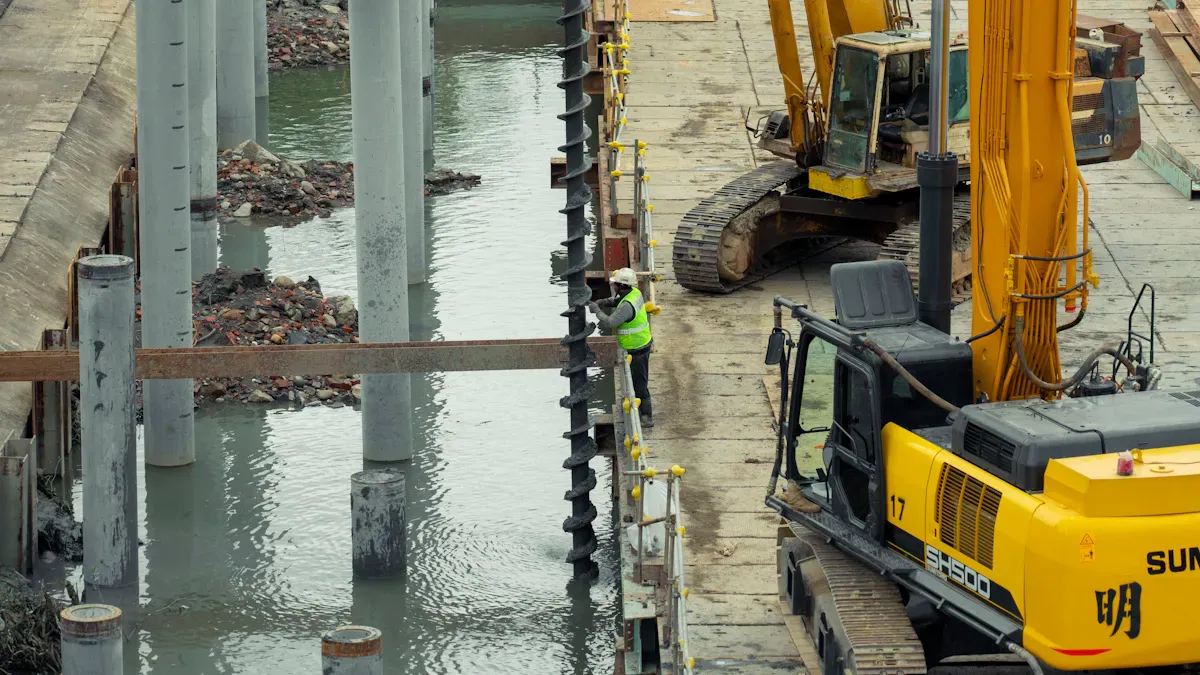
You can rely on Driven Piles 1900kN Pressure Guarantees Drive to ensure your foundation meets demanding load requirements when you use a careful design. Factors such as soil type, design rules, and selecting the right materials are crucial. For instance, in wet, sticky soils, piles may not support as much weight. CEGC prioritizes safety, durability, and the unique needs of each site throughout every design phase.
Key Takeaways
-
Learn about the kinds of loads driven piles hold, like up and down, pulling, and sideways forces. Knowing this helps make a strong base.
-
Check the soil before you design driven piles. Different soils change how much weight piles can take. This affects how steady everything is.
-
Use the right tests, like static and dynamic load tests, to make sure your piles can take the needed pressure. Good testing keeps things safe and dependable.
Driven Pile Design Principles
Load Types and Allowable Stresses
It is important to know what loads driven piles hold. These loads are vertical, pulling up, and sideways forces. The table below lists the main load types and what they mean for driven piles:
|
Load Type |
Description |
|---|---|
|
Axial Compression |
A pile or group holds up against weight pushing down. |
|
Axial Tension |
A pile or group holds up against weight pulling up. |
|
Lateral Resistance |
A pile resists sideways forces and changes shape from these forces. |
|
Settlement |
A pile group sinks under loads, which affects how stable the foundation is. |
You must make sure the stress in each pile stays safe. This keeps the driven pile foundations strong and secure.
Soil and Site Conditions
Soil type changes how driven piles work under pressure. You need to check the soil before you design driven piles. The table below shows how different soils change pile performance:
|
Soil Type |
Effect on Pile Behavior |
|---|---|
|
Cohesionless Soil |
How much weight a pile holds depends on how packed the soil is; driving piles can pack soil tighter. |
|
Saturated Cohesive |
Moving and pressing the soil makes water pressure go up, which lowers strength and weight support at first. |
|
Stiff Clays |
The soil changes a lot, which affects how much weight the pile can hold. |
-
Friction piles need the right soil and a rough pile surface.
-
Packing the soil during installation can make piles hold up to 35% more weight.
You also need to think about site problems. High water pressure and soil movement can lower pile strength. You need good equipment so you do not damage the piles or the soil.
Driven Pile Design Codes
You must use design codes for driven piles. These codes help you check both end-bearing and skin friction. Driven piles get their strength from the tip and the sides. In soft soils, skin friction is most important. In hard soils, end bearing matters more. You must use both when you do your math to keep your design safe and strong.
Tip: Always match your design to the site and use the right codes for your area.
Driven Piles 1900kN Pressure Guarantees Drive: Key Factors
Capacity Verification Methods
You need to check if your piles can hold enough pressure. For driven piles 1900kN pressure guarantees drive, you use two main tests. These are static load testing and dynamic load testing. Each test has good points and bad points. The table below shows how they are different:
|
Testing Method |
Accuracy and Reliability |
Additional Notes |
|---|---|---|
|
Static Load Testing |
Most reliable for finding out how much weight piles can hold and how they settle. |
Takes a lot of time and costs more; heavy loads can be unsafe. |
|
Dynamic Load Testing |
Uses real-world methods with changing accuracy, especially for bigger and deeper piles. |
Does not give direct results; can cause fast movements that change how piles settle and hold weight. |
You also need to watch piles as you put them in. You can use different tools to check if you meet the driven piles 1900kN pressure guarantees drive:
-
Crosshole Sonic Logging (CSL) uses sound waves to check pile length and quality.
-
Low Strain Integrity Testing uses a small force on the pile head and measures what happens.
-
Pile Echo Method checks pile length and quality by looking at stress wave reflections.
You should always keep clear records of your tests and checks. This helps you show that your piles are safe and meet the design needs.
Material Selection and Durability
You must pick the right materials for driven piles 1900kN pressure guarantees drive. The materials need to handle high pressure and last a long time. Corrosion can hurt piles, especially in wet or tough places. You can use coatings, galvanization, or thicker steel to protect piles. The table below shows how picking materials changes durability:
|
Aspect |
Description |
|---|---|
|
Protective Measures |
Multi-layer coatings, hot-dip galvanisation, and extra steel thickness at important spots. |
|
Structural Steel Grades |
Strong steel grades like S355 and S430 help piles stay tough and hold more weight. |
|
Service Life Considerations |
With good choices and protection, H piles can last for many years in harsh places. |
You should always think about corrosion when you design piles. Coatings and covers help keep piles strong. Good materials make piles last longer.
Safety Factors and Serviceability
You must use safety factors in your design for driven piles 1900kN pressure guarantees drive. Safety factors help make sure piles do not fail, even if loads change or soil is not perfect. You should check both strength and serviceability. Serviceability means piles do not move or sink too much under weight.
You need to think about how piles will work for a long time. Good design keeps piles safe and strong for many years. You should always follow the right codes and standards for your area. This keeps your project safe and dependable.
Cost and Construction Considerations
You must plan for cost and building problems when you use driven piles 1900kN pressure guarantees drive. Your equipment must be strong enough and set up right. If your site is small or has low ceilings, you may need special equipment. This can cost more and cause delays.
You should also think about how you put in the piles. Different ways work better in different soils. Some sites have hard soils or rocks that make it harder to install piles. The list below shows common problems:
-
Equipment capability and calibration: Your tools must fit the job and not harm piles or soil.
-
Installation method selection: The way you choose affects cost and how well piles go in.
-
Site conditions: Small spaces or low ceilings can make work harder and cost more.
The table below shows other problems you might face:
|
Challenge |
Description |
|---|---|
|
Loud sounds and shaking from pile driving can bother nearby areas and risk buildings. |
|
|
Depth and Load Capacity |
Hard to reach needed depth and weight limits, especially in tough soils. |
|
Material Damage |
Piles can get damaged during installation, so careful handling and quality checks are needed. |
|
Soil Conditions |
Hard to install piles in very dense soils, hard rock, or places with blockages. |
You should always plan for these problems in your design. Good planning helps you control costs and finish your project on time.
You can get reliable 1900kN pressure guarantees for driven piles if you follow good steps. Always check your materials and equipment. Use the right construction controls. The table below explains why codes and checking are important:
|
Design Factor |
Description |
|---|---|
|
Maximum Allowable Design Stresses |
Limits help piles stay strong when used and put in place. |
|
Factor of Safety |
Safety factors make piles safer and more dependable. |
|
Static Load Capacity |
Good design fits the site and materials for safe loads. |
-
Use tools to check things you cannot see.
-
Follow codes and check each step to make sure you succeed.
FAQ
What is the main benefit of using driven piles for heavy loads?
You get strong support for buildings. Driven piles can hold heavy loads, like 1900kN, and work well in many soil types.
How do you check if a driven pile meets the 1900kN pressure guarantee?
You use static or dynamic load tests. These tests show if your pile can safely hold the required pressure.
Can you use driven piles in wet or soft soils?
-
Yes, you can use driven piles in wet or soft soils.
-
You must check soil conditions first to choose the right pile type and design.


