
You face real obstacles when you work on micro tunneling mixed strata needs capacity. Drilling can mean cutting through brick with hidden objects. Soils can shift from hard-packed to soft and loose. Sometimes, you only get access from one end. CEGC gives you the right machines for these tough jobs.
Key Takeaways
-
Micro tunneling in mixed strata needs powerful machines. These machines must work with different ground types. Pick equipment based on soil and rock. This helps your project succeed.
-
Advanced ground investigation is very important. Use boreholes and geophysical surveys to check underground conditions. Do this before you start your project.
-
Real-time monitoring lets you find problems early. Watch key metrics to keep things safe. This also helps you finish your project on time.
micro tunneling mixed strata needs capacity
challenges of tunneling in mixed strata
Microtunnelling in mixed ground is tricky. The ground can change fast. It might go from clay to sand or rock in a few meters. Each ground type has its own problems. Clay can make thrust go up by 15%. Rock can make thrust drop by 10%. Sand can cause the surface to settle and slow down work. The table below shows how these things affect your project:
|
Factor |
Clay |
Sand |
Rock |
|---|---|---|---|
|
+15% Baseline |
±5% |
-10% |
|
|
Contingency Budget |
8–12% |
5–8% |
15–20% |
|
Delay Frequency |
42% of jobs |
28% of jobs |
57% of jobs |
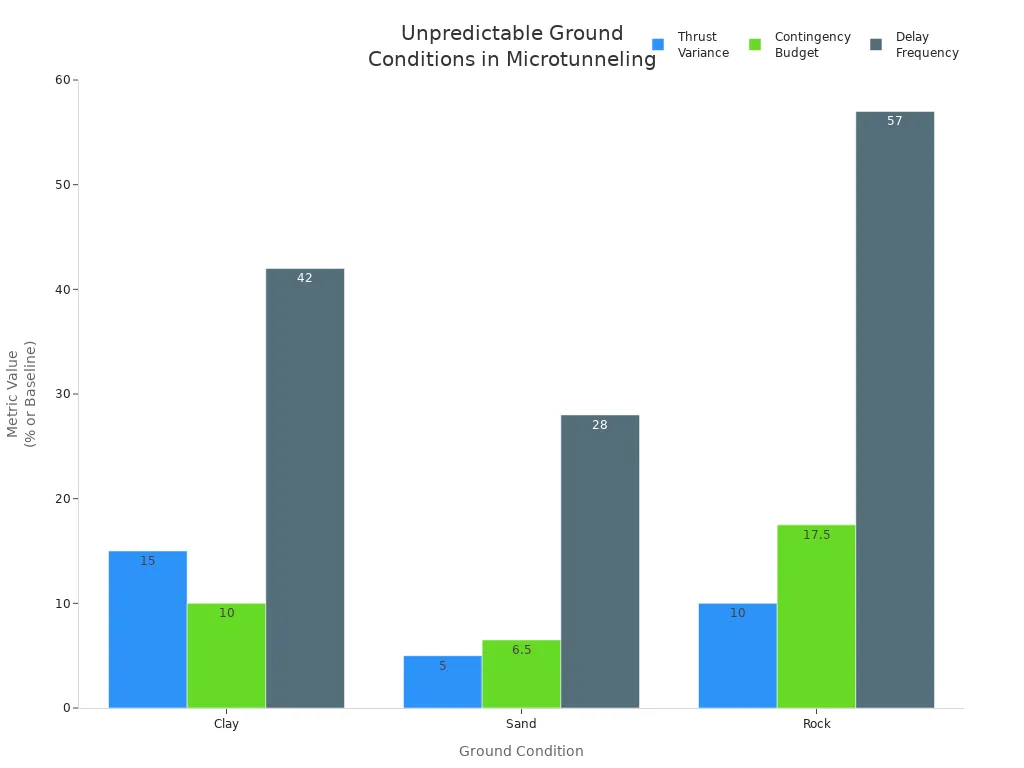
Mixed strata can wear out your cutting head. This happens more in quartz-rich layers. You need strong tools to keep working. Micro tunneling mixed strata needs capacity, not hope. You must use machines that can handle different ground types and keep the ground safe.
risks in tunneling in urban areas
Urban areas bring more problems. You work in small spaces with traffic and buildings nearby. The table below shows common problems with infrastructure:
|
Constraint Type |
Description |
|---|---|
|
Limited Working Space |
Traffic and buildings make shaft building and setup hard. |
|
Congested Subsurface Environment |
Utilities like water, sewer, and cables fill the underground. |
|
Coordination and Relocation |
Sometimes you must move shafts or change networks. |
|
Variable Ground Conditions |
You need to change methods as the ground changes. |
|
Groundwater Influence |
Special support is needed to keep the tunnel safe. |
Limited access and old infrastructure make digging harder. Utility clashes can stop your project and cause safety issues. Micro tunneling mixed strata needs capacity to plan and act carefully. CEGC gives tunnel boring machines, auger boring machines, and microtunnelling machines that meet standards. These machines help you solve problems in mixed ground and city areas.
solutions for microtunnelling challenges
advanced ground investigation
You must know what is underground before tunneling starts. Advanced ground investigation helps you learn about soil, rock, and water. You can use boreholes, geophysical surveys, and lab tests. These tools show where the ground changes. If you understand the ground, you can plan your tunnel and pick the right method.
Many microtunnelling projects use advanced ground investigation. For example, the Brushy Creek Tunnel project used grouting before tunneling to make the ground safer. The Las Vegas Wash Tunnel used grouting before digging to stop groundwater problems. These steps made tunneling safer and faster.
custom tunnel machine selection
You need to choose the best tunnel machine for your project. Each machine works best in certain ground types. You must look at the soil, rock, and water. You also need to think about tunnel size, shape, and how fast you need to finish. The table below shows what you should check when picking a tunnel machine:
|
Criteria |
Description |
|---|---|
|
Ground Conditions |
Soil composition, rock hardness, and groundwater levels influence machine choice. |
|
Tunnel Dimensions & Geometry |
Diameter and shape requirements determine machine size and design. |
|
Project Requirements |
Tunnel length, alignment, and schedule deadlines affect automation and excavation speed needs. |
|
Surface Conditions |
Urban areas or environmentally sensitive zones require minimal surface disruption. |
A TBM tunnel boring machine is good for long, straight tunnels in hard rock. An auger boring machine works well in soft ground or short tunnels. Microtunnelling machines are good for mixed strata and city areas. CEGC gives you custom solutions for every tunneling job.
ground improvement and conditioning
Sometimes, you must make the ground better before tunneling. Ground improvement methods like compensation grouting and soil mixing help control settlement. These methods can stop the ground from sinking or moving. You can use additives to make the soil stronger or easier to dig.
Here are some proven ground improvement techniques:
|
Evidence Type |
Details |
|---|---|
|
Soil Conditioning Method |
Auxiliary air pressure balance mode for EPB shield tunneling |
|
8–10 cm for effective muck discharge |
|
|
Ground Displacement |
Monitored values were below allowable limits, indicating stability |
|
Tunneling Behavior |
No adverse effects on subsequent lining rings after pressure changes |
Compensation grouting can control heave and settlement. It may take more time, but it can save money in tough ground. In deep, loose soil, grouting may be the best choice. It can cost less than other methods like drilled shafts.
real-time monitoring and interventions
You must watch your tunnel all the time. Instrumentation and monitoring help you see what is happening underground. Real-time monitoring lets you check jack speed, torque, and ground movement. If something changes, you can act fast. This keeps your tunnel safe and your project on track.
Here are ways real-time monitoring helps you:
-
You can predict problems by watching key numbers like jack speed and torque.
-
The system links your choices to machine actions, so you avoid mistakes.
-
You get alerts when things go wrong, so you can fix them quickly.
-
Instrumentation and monitoring reduce risks from human error and ground changes.
When you find a problem, you can use these interventions:
|
Intervention Type |
Description |
|---|---|
|
Operational Adjustments |
Adjusting advance rates, slurry properties, or adding face support to maintain stability during excavation. |
|
Contingency Plans |
Preparing for obstructions by having strategies to remove or adjust tunnel alignment as needed. |
|
Groundwater Management |
Increasing dewatering capacity and modifying grout formulations to handle excess water inflows. |
-
You can reinforce the ground, balance slurry pressure, or add tunnel lining.
-
These steps help you control settlement and keep the tunnel safe.
Microtunnelling in mixed strata needs strong solutions. You must use advanced ground investigation, pick the right tunnel machine, improve the ground, and use real-time monitoring. Instrumentation and monitoring give you the data you need. With these tools, you can finish your tunneling project safely and on time.
You cannot just hope to do well in mixed strata microtunneling. You need to use smart strategies to get good results:
-
Make the ground stronger with grouting or dewatering.
-
Put extra support in places that are weak.
-
Watch the tunnel closely with strong monitoring systems.
|
Why pick experienced suppliers? |
|---|
|
They have real solutions, good skills, and finish projects you can trust. |
FAQ
What makes tunneling in urban areas so challenging?
Tunneling in cities is hard for many reasons. There is not much space to work. Old pipes and wires are everywhere underground. The ground can change quickly. You must plan carefully and use strong machines.
How do you choose the right tunnel machine for urban projects?
You need to check what kind of ground is there. You also look at how big the tunnel needs to be. Think about what the project needs. Machines for city jobs must work in mixed ground. You want machines that work well every time.
Why is real-time monitoring important for tunneling in urban areas?
Real-time data helps you find problems early. City ground can change fast. Monitoring keeps the tunnel safe and stops delays.
-
Sensors can watch how the ground moves.
-
You get alerts if something changes below the surface.
|
Benefit of Monitoring |
Impact on Urban Projects |
|---|---|
|
Early Problem Detection |
Less waiting during city tunneling |
|
Safety Improvement |
Keeps people and buildings safe |


