
You need to use uniform force when you drive piles. This practice stops stress points from forming. Stress points can damage piles and soil. CEGC shows that uniform force keeps structures strong. Pile Driver Uniform Force Beats Stress Points because it gives you safer and more predictable results.
Key Takeaways
-
When you use the same force to drive piles, it stops stress points from forming. This keeps the piles and soil safe and strong. Using the same force gives results you can expect. It helps finish the project faster and makes fewer mistakes. Picking the right tools, like vibratory hammers, makes work better. It also keeps piles and things around them safe.
Uniform Force vs. Stress Points in Pile Driving
What Is Uniform Force Application?
Uniform force application means you use the same energy everywhere on the pile. This way, you do not make weak spots and the pile stays strong. Engineers follow rules like WEAP, LRFD, and AASHTO for this. These rules help stop pile damage and fix problems like downdrag and earthquake risks.
|
Standard/Guideline |
Description |
|---|---|
|
WEAP |
Stops pile damage when force is not even |
|
LRFD 10.7.3.6, 10.7.3.7 |
Fixes downdrag and loss from scour and liquefaction |
|
AASHTO SGS 6.8 |
Gives earthquake rules for pile design |
Uniform force spreads stress the same way as the pile goes down. You see less change in stress, and the pile can hold more weight. The table below shows how uniform force and stress points are different:
|
Aspect |
Uniform Force Behavior |
Stress Points Behavior |
|---|---|---|
|
Stress Distribution |
Stays even as pile gets deeper |
Stays in one spot at depth |
|
Coefficient of Variation |
Gets smaller with depth |
Gets bigger with depth |
|
Time Dependency |
Stress gets more even over time |
Local changes happen, but overall stress evens out |
|
Bearing Capacity |
Gets better with even stress |
Stays low because of stress in one spot |
How Stress Points Occur
Stress points happen when force is not spread out evenly. This can happen if the hammer does not work right or the pile is not straight. Too much stress at the top or things in the soil can also make stress points.
-
Hammer and pile are not lined up
-
Too much stress at the top
-
Things in the soil block the pile
If you drive a pile with uneven force, the pile and soil push on each other in small spots. Soil grains press on the pile, and friction changes along the pile. If the soil gets soft and stretches, the stress gets bigger. Tests show stress builds up about 20 mm from the pile bottom. These stresses are much higher than other places. When the load gets close to what the pile can hold, friction on the pile drops, especially for smooth piles. This is why Pile Driver Uniform Force Beats Stress Points and keeps your project safe.
Why Pile Driver Uniform Force Beats Stress Points
Preventing Pile Damage and Failure
You can stop piles from breaking by using uniform force. When you drive piles with the same energy, the load spreads out. This keeps the pile from bending or folding. You do not get weak spots that can crack or snap. If you use uneven force, the pile can move out of place. This can hurt the pile and the building above it.
Pull-out failure at a pile does not make the solar array fall right away, but it moves the panel row above the bad pile, makes the panels not line up, and can break the frames. In bad cases, it puts too much weight on other piles.
Pile Driver Uniform Force Beats Stress Points because it keeps piles straight and strong. You stop the pile from moving suddenly and keep it in place. Uniform force also stops damage from spreading to other piles. You build a safer base for your project.
Protecting Soil and Surrounding Structures
Uniform force keeps the soil and buildings safe. You spread the energy over more ground, so the soil does not move as much. You lower the chance of cracks or ground shifts. You also keep shaking away from homes and offices. The table below shows how pile size, soil type, and distance help keep things safe:
|
Evidence Description |
Key Findings |
|---|---|
|
Spread energy over more ground, so the soil and buildings shake less. |
|
|
Soil type impact |
Harder soils like clay stop shaking better than soft soils like sand. |
|
Distance from pile-driving point |
More distance means less shaking because energy gets weaker. |
Pile Driver Uniform Force Beats Stress Points by keeping the ground steady and buildings safe. You stop damage to walls and foundations. You also make less noise and shaking. Many studies show what happens if you do not use uniform force:
|
Study |
Findings |
Maximum PPV (mm/s) |
Notes |
|---|---|---|---|
|
Jaksa et al. |
Studied shaking from big piles |
8.8 |
Safe for homes |
|
Madheswaran and Thandavamoorthy |
Looked at pile driving near other piles |
60-100 |
Too much shaking, can hurt buildings |
|
Woods et al. |
Studied shaking during pile driving |
N/A |
Saw more shaking |
|
Veshnyakov |
Measured top shaking speeds |
0.5 |
Average for a five-story building on clay |
|
Karim et al. |
Studied soil shaking on buildings |
Over safe limits |
Said not to use hydraulic hammers in cities |
You do not have these problems when you use uniform force. You keep your project safe and protect people nearby.
Achieving Predictable Results
Uniform force helps you get the same results every time. You finish faster and make fewer mistakes. Machines drive piles with the same energy each time. You get piles that go in evenly and stay strong. You also waste less time and materials. The table below shows how uniform force helps your work:
|
Benefit |
Contribution to Project Timelines and Outcomes |
|---|---|
|
Enhanced Efficiency |
Machines put in piles up to five times faster than people. |
|
Precision Control Systems |
Piles go in the right spot, so you waste less. |
|
Reduced Labor Requirements |
One person can do jobs that used to need many workers. |
|
Consistent Driving Performance |
Piles go in evenly, so the base is strong. |
|
Year-Round Construction |
Machines work well in any weather. |
|
Safety Improvements |
Workers stay safe inside cabins. |
|
Environmental Benefits |
Less noise and shaking means less harm to the area. |
|
Quality Control |
Machines check and record that piles go in right. |
|
Increased Project Capacity |
Machines can handle different pile sizes without big changes. |
Pile Driver Uniform Force Beats Stress Points by making your job easier and better. You get strong piles, safe ground, and steady work. You can trust your results and finish on time. You also keep workers and nature safe.
Best Practices for Uniform Force Application
Methods and Equipment
You can get uniform force by picking the right pile driving equipment. You also need to set it up for your soil. Vibratory hammers work well in many types of soil. They make less noise and shaking than impact hammers. The noise and shaking can be 80% less. You can finish the job two or three times faster if the soil is right. Vibratory hammers do not hit the pile over and over. This helps protect pile welds and coatings.
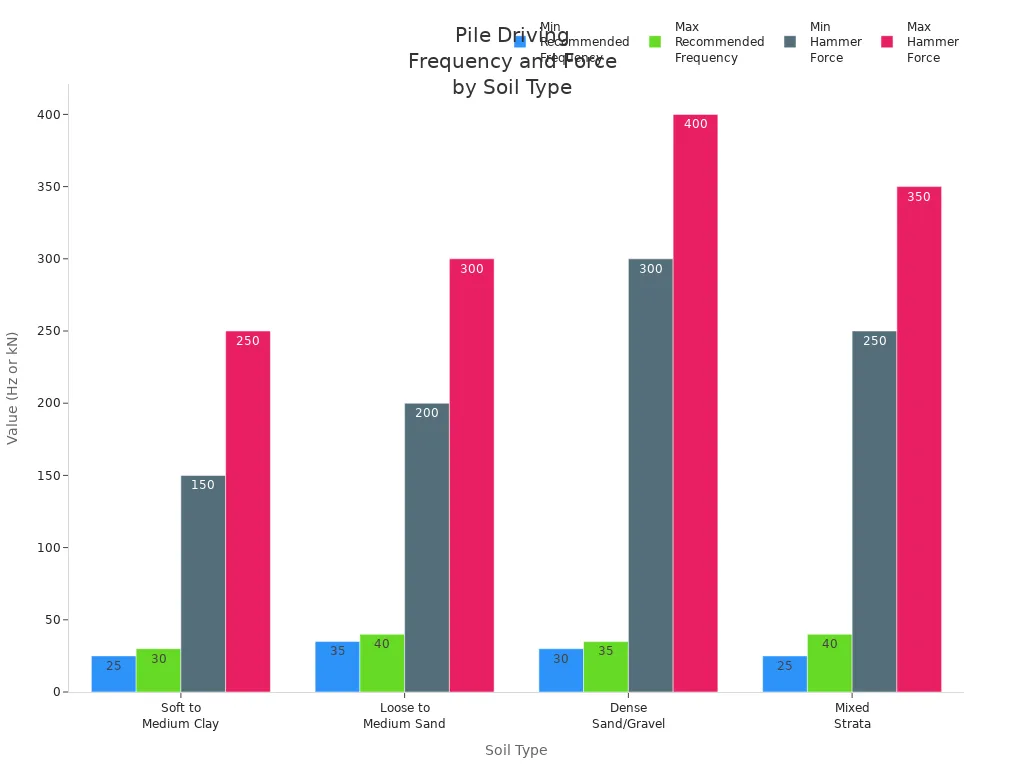
The table below shows how to set hammer settings for different soils:
|
Soil Type |
Recommended Frequency |
Hammer Force Range |
Key Consideration |
|---|---|---|---|
|
Soft to Medium Clay |
25-30 Hz |
150-250 kN |
Lower frequency breaks cohesion |
|
Loose to Medium Sand |
35-40 Hz |
200-300 kN |
Higher frequency reduces friction |
|
Dense Sand/Gravel |
30-35 Hz |
300-400 kN |
Maximum force penetrates resistance |
|
Mixed Strata |
25-40 Hz (Variable) |
250-350 kN |
Adjustability is critical |
Many jobs use vibratory hammers first and impact hammers last. This way, you put piles in fast and check their strength. New machines help keep piles straight and use even force. Adjustable leads and guides keep piles in the right place. Real-time monitors show if the pile is going as planned.
On-Site Quality Control
You must watch the pile driving closely to keep force even. Torque monitors tell you right away how much force you use. High-strain tests check how well the pile works as you drive it. These tools help you find problems early.
Sometimes, the soil changes or you hit something hard. If this happens, you need to check the site again and change your plan. Automation and robots now help keep quality high. Hydraulic pile drivers give you better control. They make sure each pile goes in at the right depth.
Pile Driver Uniform Force Beats Stress Points when you use good equipment, watch your work, and change plans for the site. You build safer and stronger foundations by following these best steps.
You make foundations stronger by using uniform force. Uniform force helps piles stay safe and steady. It protects your project and saves time. Prestressed concrete piles can last more than 100 years. They do not rot or decay. Bugs cannot damage them. You need fewer repairs and the piles work as expected.
-
Prestressed concrete piles do not rot or decay.
-
Bugs cannot harm them.
-
They last more than 100 years without big repairs.
-
You spend less on repairs and know how the piles will work.
FAQ
What happens if you use uneven force when driving piles?
You might get cracks in the pile. The soil can also get damaged. The foundation may not be strong. Piles can bend or even break. Using uniform force keeps everything safe.
How do you check if force stays uniform during pile driving?
You can use monitors that show results right away. Torque sensors also help you check the force. These tools let you see changes fast. If you find a problem, fix your equipment.
Why do engineers prefer vibratory hammers for uniform force?
Vibratory hammers spread energy the same way. There is less noise and less shaking. You can finish the job faster. They also protect the piles and the soil.


