
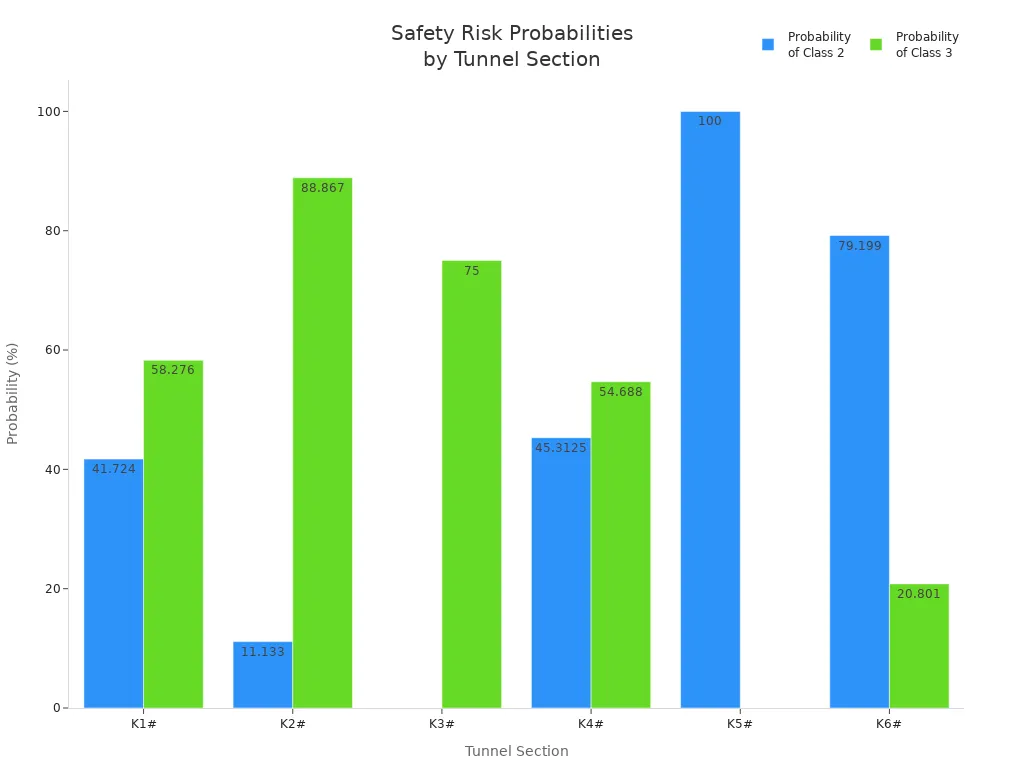
You can see how thrust from a tbm often leads to cracks in a tunnel segment, which puts safety and cost at risk. The table below shows that poor segment integrity increases the chance of high-risk tunnel sections. Balanced thrust can cut segment cracks in a TBM tunnel. CEGC helps you achieve safer tunnels.
|
Tunnel Section |
Integrity Level |
Safety Risk Classification |
Probability of Class 2 |
Probability of Class 3 |
|---|---|---|---|---|
|
K1# |
Poor |
C3 |
41.724% |
58.276% |
|
K2# |
Poor |
C3 |
11.133% |
88.867% |
|
K3# |
Broken |
C3 |
0% |
75.000% |
|
K4# |
Broken |
C3 |
45.3125% |
54.688% |
|
K5# |
Good |
C2 |
100.000% |
0% |
|
K6# |
Poor |
C2 |
79.199% |
20.801% |
Key Takeaways
-
Balanced thrust is very important to stop segment cracks in TBM tunnels. It makes the load spread out across segments, so there is less stress and damage.
-
Checking and changing thrust often can keep the tunnel safe. Use sensors and real-time data to make sure forces stay balanced.
-
Follow best practices like making penetration rates better and doing regular maintenance. These steps make the tunnel stronger and safer.
Understanding TBM thrust and segment cracks
What is TBM thrust?
A tunnel boring machine moves through soil or rock. It pushes forward using hydraulic jack pads. This pushing force helps build the tunnel. In some projects, thrust keeps the tunnel steady. It also lets workers put in segments fast. Each jack pad can push up to 22.2 MN. At this force, only tiny cracks show up. When the force is 9.55 MN, cracks appear on the surface. These cracks are very thin, less than 0.2 mm wide.
How thrust affects tunnel segments
Thrust jack pads push on tunnel segments. This pushing makes the segments stretch inside. If the force gets too high, you see bursting and spalling. Normal thrust does not hurt the segments much. Too much force can break them in a circle. These stresses make cracks and weaken the tunnel. You need to watch the thrust to keep segments strong.
Common causes of segment cracks in TBM tunnels
Cracks in tunnel segments happen for many reasons:
-
TBM jacks push too hard
-
Segment ring surfaces are not even
-
Jack grippers press in the wrong way
-
TBM is not lined up in curved tunnels
-
Too much pressure during grouting
-
Bad support under the segments
-
Segments are put in the wrong way
-
Too much stretching, breaking, or bursting
Bad segment design and wrong alignment also cause cracks. If there is not enough space between the segment lining and the TBM shield, they can touch and crack. If segments are not lined up right, they bend and break. You need to check these things to stop cracks and make tunnels safer.
Balanced thrust can cut segment cracks in a TBM tunnel
Why balanced thrust matters in tunnel boring
You need to keep forces even when you use a tunnel boring machine. Balanced thrust can cut segment cracks in a TBM tunnel by spreading the load across each segment. When you balance the thrust, you protect the tunnel from damage. If you do not balance the force, some segments get more stress than others. This can lead to cracks, spalling, or even broken segmental lining.
During tunnel construction, you see that jack thrust, friction, and bolt preload all work together. These forces change a lot at first, but they settle down when you balance the thrust. This even force keeps the segmental lining strong and stops cracks from forming. You also help the tunnel last longer because balanced thrust reduces wear and tear on each segment.
You can see how balanced thrust works in different TBM systems. For example, the EPB-TBM controls pressure inside the excavation chamber. This keeps earth and water pressure steady. When you monitor thrust and torque, you make sure the tunnel stays safe and the segmental lining does not crack.
Tip: Always check the thrust force and segment alignment during every advance. This simple step can prevent costly repairs and keep your tunnel safe.
Methods to achieve balanced thrust in TBM machines
You have many ways to keep thrust balanced in a tunnel machine. Modern TBM technology uses sensors and control systems to help you. You can use thrust modeling to predict how much force you need. This helps you avoid putting too much stress on any one segment.
Here are some methods you can use:
|
Method |
Description |
|---|---|
|
Thrust Modeling |
Predicts the right amount of force for each segment and adjusts as needed. |
|
Parameter Adjustment |
Changes the force based on real-time data to keep the load even. |
|
Pressure Control |
Keeps the pressure inside the chamber steady to protect the segmental lining. |
|
Monitoring |
Lets you watch thrust and torque so you can fix problems fast. |
You should also use a mechanical model to understand how the thrust system works. This model shows you how force moves through the tunnel machine. Hydraulic cylinders push the TBM forward and help you steer. When you adjust the thrust, you keep the tunnel on track and protect the segmental lining.
Note: Regular maintenance and quick access to spare parts help you keep the TBM running smoothly. This reduces downtime and keeps the segmental lining safe.
Practical steps for operators and CEGC solutions
You can follow simple steps to make sure balanced thrust can cut segment cracks in a TBM tunnel. Start by testing your setup. Apply different forces to see how each segment reacts. Simulate support conditions to check for weak spots in the segmental lining. Use load pads to test single segments under different thrusts. This helps you find the best way to protect the tunnel.
Here are some best practices for TBM operators:
-
Optimize the penetration rate. Lower RPM can help you get better results and reduce cutter wear.
-
Work with a skilled crew. Experienced operators know how to adjust thrust and speed for changing ground.
-
Set aside time for maintenance. Regular checks and cutter changes prevent segment damage.
-
Monitor ground conditions. Be ready to adjust thrust if you see changes in soil or water pressure.
You can see the results in real projects. For example, different thrust jack setups show how cracks form. The French method saw cracks at the joints farthest from the loading surface. The German method had possible crushing in the longitudinal joints. The Japanese method had the smallest cracking area and no cracks under minimum thrust. These examples show that balanced thrust can cut segment cracks in a TBM tunnel and keep the segmental lining strong.
CEGC offers advanced TBM machines and support for your tunnel construction. You get real-time monitoring, robust thrust modeling, and expert advice. With CEGC, you can keep your tunnel safe, reduce segment cracks, and extend the life of your segmental lining.
Remember: Balanced thrust can cut segment cracks in a TBM tunnel. Use the right methods, follow best practices, and choose reliable equipment like CEGC for your next project.
You can stop segment cracks in tunnels by keeping thrust even and using good methods. Good segment design and watching stress make your tunnel strong and safe. Look at the table below for main ideas. If you need help with your TBM project, ask CEGC.
|
Key Point |
Description |
|---|---|
|
Balanced Thrust |
Reduces segment cracks and stress |
|
Segment Design |
Maintains tunnel durability and safety |
|
Expert Guidance |
CEGC helps optimize construction and operation |
FAQ
What causes segment cracks in a tunnel?
Segment cracks can happen when the tunnel is not lined up right. This means the segments do not fit together as they should. When this happens, each segment gets more stress. Misalignment can start during building or if the ground is not even.
How does misalignment affect tunnel safety?
When the tunnel is not lined up, segments can break more easily. You might see cracks form because of this problem. Misalignment makes the tunnel weaker and fixing it is harder.
Can you prevent segment cracks from misalignment in tunnel construction?
You can stop cracks by checking for misalignment many times. Finding misalignment early lets you fix it before it gets worse. Keeping segments lined up helps them stay strong and keeps the tunnel safe.


