
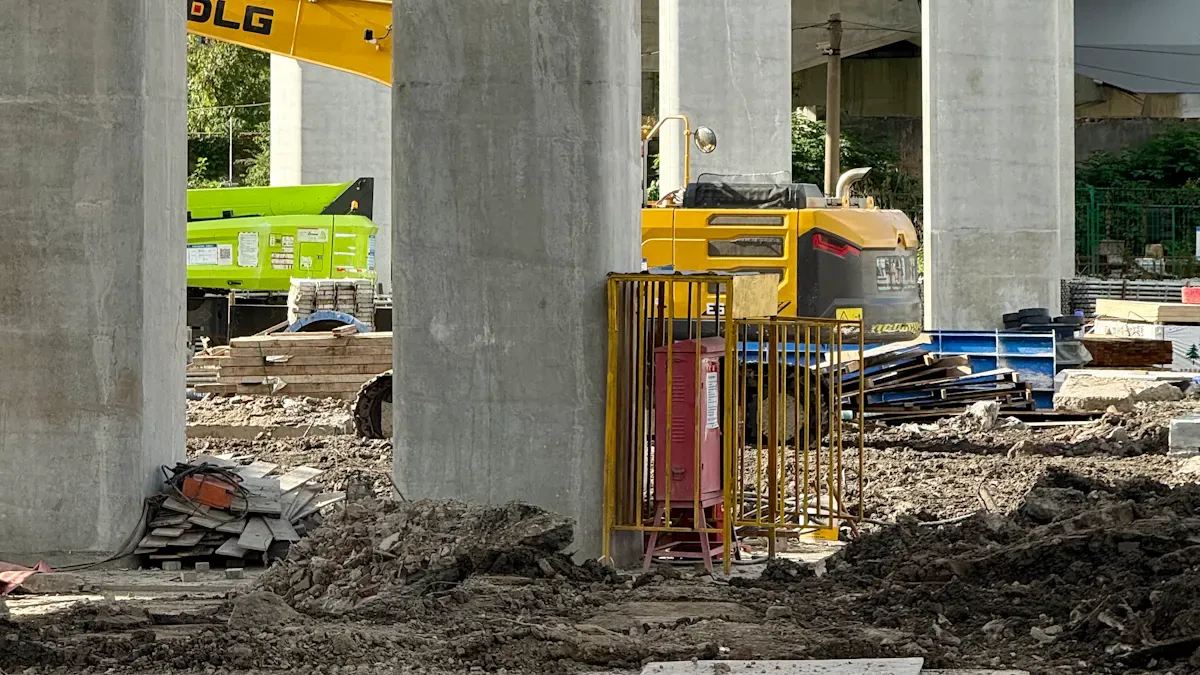
Imagine you push a nail into wood with steady pressure instead of sharp hits. You get a smoother result. In pile driving, uniform force works the same way. Newton’s second law shows this. Pile Drive Uniform Force Beats Concentration. CEGC uses this method for better construction results.
Key Takeaways
-
Using uniform force in pile driving gives smoother and safer results. It helps the pile go into the ground slowly and without jumps.
-
Newton's second law links force, mass, and acceleration. Knowing this helps you find the right force for good pile driving.
-
Do not use concentrated force because it can cause damage. Spreading force out keeps piles strong and lowers the chance of cracks or breaks.
Uniform Force And Acceleration
Defining Uniform Force
Uniform force happens when you push something with the same pressure. In mechanics, this means you use equal force all the time. This steady push makes the object move in a way you can guess. When you use uniform force, you decide how the object moves. The object does not speed up or slow down fast. It gets faster at the same rate. This is called uniform acceleration. In pile driving, uniform force helps the pile go into the ground smoothly. You do not get sudden jumps or stops. This makes the work safer and better.
Newton's Second Law And Acceleration
Newton’s second law is important in mechanics and dynamics. It says force equals mass times acceleration. You can write it as F = ma. This law links force, mass, and acceleration in every movement. In pile driving, you use this law to know how much force you need. If you know the pile’s mass and the acceleration you want, you can find the force. The equations of motion show how speed changes when you use force. Here are some main equations of motion in mechanics:
|
Equation |
Description |
|---|---|
|
v = u + at |
Final velocity, initial velocity, acceleration, and time |
|
s = ut + 1/2 at² |
Initial velocity, distance, acceleration, and time |
|
v² = u² + 2as |
Final and initial velocities, distance, and acceleration |
You use these equations in kinematics to guess how things move. When you use uniform force, you get uniform acceleration. This means speed goes up at the same rate during the movement. Mechanics and dynamics use these ideas to fix real problems.
Pile Drive Uniform Force Beats Concentration
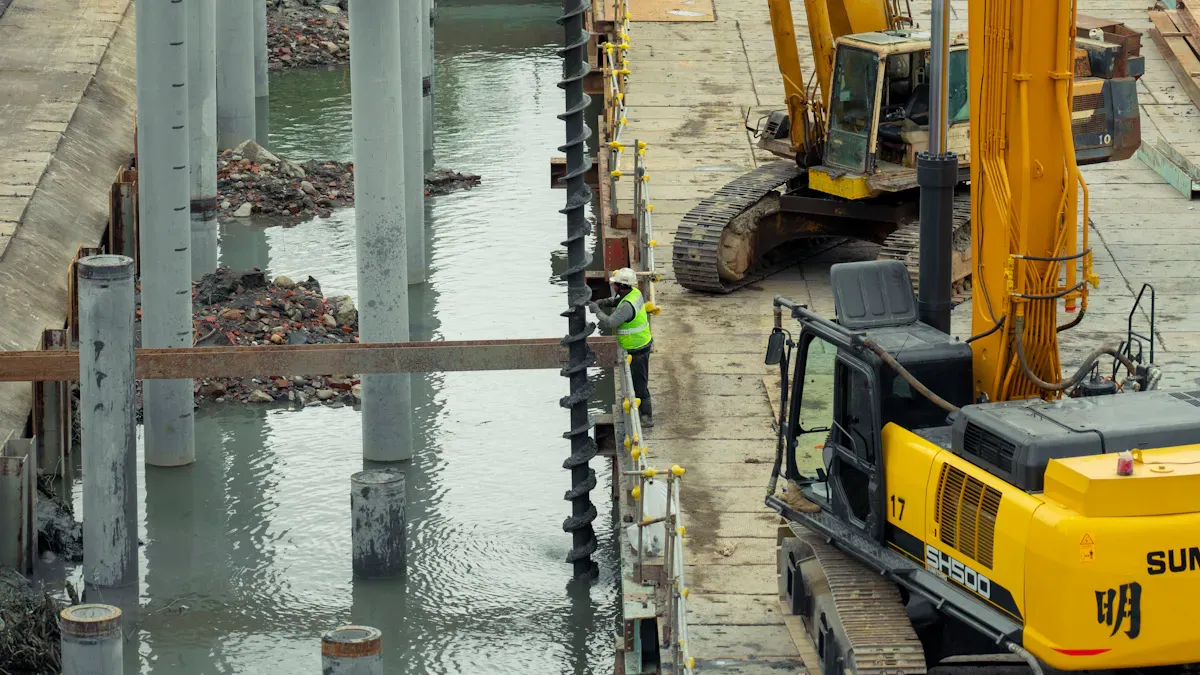
Comparing Force Distribution
You might ask why pile drive uniform force beats concentration in real building work. When you push on a pile with even force, the load spreads out over the whole pile. This helps the pile stay strong and not bend. If you use force in just one spot, it puts too much pressure there. This can make the pile crack or even break.
-
Multi angle pile driving turns side forces into straight, downward pushes. This lowers bending stress and helps the pile stay in place.
-
When you use raked piles, they work together to make a strong base. Each pile takes some of the force, so no pile gets too much.
-
Uniform force also helps the pile deal with ground changes, like shaking or moving. The pile stays steady and holds up the building.
You can see that pile drive uniform force beats concentration because it keeps the pile and the whole building safe. You get better results when you spread the force instead of putting it all in one spot.
Tip: If you want your pile to last longer and stay strong, always use uniform force instead of sharp, concentrated hits.
You also need to think about safety. When you use uniform force, the ground under your machines stays steady. The table below shows how using mats to spread the force helps keep your team safe:
|
Evidence Description |
Impact on Safety |
|---|---|
|
Properly designed mat systems lower ground pressure by spreading crane and piling loads over a bigger area. |
This helps stop the ground from sinking too much and keeps equipment platforms even, which is very important for crew safety. |
|
Temporary ground protection mats are very important in modern piling jobs, especially in soft soils and sensitive places. |
They help keep equipment steady and lower safety risks on tough job sites. |
|
Ground protection mats help spread heavy loads that are bigger than normal. |
This stops the ground from sinking and keeps the work area safe for the crew. |
|
The right mat thickness and stiffness are needed to keep things steady under repeated loads. |
This steadiness is key for keeping pile driving crews safe while they work. |
Consistent Acceleration In Pile Driving
When you use pile drive uniform force beats concentration, you get steady acceleration. This means the pile moves into the ground at the same speed. There are no sudden jumps or stops. The pile’s speed goes up smoothly, so it is easy to control.
If you use concentrated force, you get sharp changes in speed. The pile might move too fast for a second, then slow down or stop. This rough motion can hurt the pile or the ground. It also makes the work loud and shaky. If you push too hard, you send more shaking through the ground. This can shake nearby buildings and make the job less safe.
The type of soil matters too. Sandy soil lets more shaking pass through, but clay holds it back. If you use uniform force, you keep shaking and noise lower. This helps protect the area around your project.
Simulation models help show why pile drive uniform force beats concentration. The cylindrical hole expansion method shows how the pile pushes soil away in a smooth way. Finite element analysis lets you test how different forces change the pile and soil. The strain path method helps you guess how the soil will move as the pile goes in. These models all show that uniform force gives you better control over speed and movement.
You can sum it up like this:
-
Uniform force gives you steady speed and smooth movement.
-
Concentrated force causes rough motion and can hurt piles.
-
Pile drive uniform force beats concentration for safety, strength, and control.
If you want your project to do well, remember that pile drive uniform force beats concentration every time.
Uniform Circular Motion And Force
Centripetal Acceleration Explained
Uniform circular motion happens when something moves around a center at the same speed. The distance from the center does not change, but the direction always does. The velocity points along the circle’s edge, but acceleration points to the center. This kind of acceleration is called centripetal acceleration. You can use the formula v²/r to find it. If the speed gets faster, centripetal acceleration gets bigger. If the circle gets wider, centripetal acceleration gets smaller.
Centripetal force makes the object stay in a circle. This force always pulls toward the center. Without it, the object would go straight instead of turning. You see centripetal force when you swing a ball on a string or when a car turns. The thing that gives centripetal force can be different. Sometimes friction gives it, like tires gripping the road. Sometimes gravity gives it, like the moon going around Earth.
-
Uniform circular motion needs centripetal force to keep the object moving in a circle.
-
Centripetal acceleration always points to the center.
-
The velocity changes direction, not speed, as the object goes around.
Linear Vs. Circular Acceleration
You can look at linear and circular motion by seeing how acceleration works. In linear motion, acceleration happens when speed changes in a straight line. The direction stays the same. In circular motion, the speed can stay the same, but the direction changes all the time. This means there is always acceleration, even if speed does not change.
Centripetal acceleration is not the same as linear acceleration. In circular motion, centripetal acceleration comes from changing direction, not changing speed. You need centripetal force to keep something moving in a circle. Engineers use these ideas for roller coasters, cars, and satellites. You must know about forces in circles to keep things safe and working right. When something moves in a vertical circle, like a roller coaster loop, it also needs centripetal force to stay smooth and safe.
-
Centripetal force is important for both sideways and up-and-down circles.
-
You see centripetal force in many places, like spinning rides and planets.
-
Knowing about centripetal force and acceleration helps you solve problems with motion and rotation.
Real-World Scenarios
Construction Examples
You see the power of uniform force in many construction projects. When you drive piles into the ground, you want each pile to move with steady motion. This helps you control the pile’s velocity as it goes deeper. If you use a machine that gives a constant force, you get smooth motion and less damage to the pile. You also protect the soil around the pile. Engineers use sensors to check the velocity of the pile during motion. If the velocity stays steady, you know the force is uniform. This keeps the pile straight and strong.
Uniform force in construction means safer work and better results. You avoid sudden jumps in velocity that can break piles or shake buildings.
You also see this in concrete pouring. Workers spread the concrete with even force. This keeps the motion of the mix smooth. The velocity of the flow stays the same, so the surface looks flat and strong.
Everyday Analogies
You can find examples of force and motion in your daily life. When you ride a bike, you push the pedals with steady force. This makes your velocity increase at a smooth rate. If you push hard all at once, your motion becomes jerky. You might even lose control. When you row a boat, you pull the oars with even force. The boat’s velocity changes in a smooth way. You feel the difference in motion right away.
-
Pushing a shopping cart with steady force keeps its velocity smooth.
-
Rolling a ball with even force makes its motion easy to predict.
You can use these examples to understand why engineers want uniform force in big projects. You see the same rules of motion, force, and velocity at work everywhere.
Misconceptions About Force
Concentrated Force Myths
Some people think strong, concentrated force works best. This idea is popular, but it is not true in real life. If you push hard on one small spot, you can hurt the material. Cracks might show up, and the pile could break. You also lose control of how things move. The velocity can change fast, which is not safe. Many believe a quick, hard hit will drive a pile faster. But this makes the pile move unevenly and can bend or shift it. You do not get steady velocity, and the force does not spread out. This causes weak spots and more repairs.
For smooth motion and safe results, avoid sharp, concentrated force.
Importance Of Uniformity
Uniform force is very important in engineering and construction. When you use steady force, you control motion and keep velocity steady. This stops sudden changes that can damage tools or materials. Uniform force helps in many ways:
-
Stable equipment keeps motion repeatable and lowers waste.
-
Uniform heating stops weak spots and keeps velocity even.
-
Good binder and dispersant use spreads force and keeps motion smooth.
When you use uniform force, velocity stays reliable in your process. You also lower the risk of cracks and defects. Consistent motion helps you guess how materials will act. This leads to better quality and safer work. Always use uniform force for the best results in any project.
You can see that uniform force helps you control pile driving better. It also makes the work safer. Studies show that energy loss and hammer problems change how well the job goes. You can use tools to check force and acceleration in real projects. Force sensors measure force at important spots when things hit. Accelerometers measure acceleration so you can find force right away.
|
Experimental Technique |
Description |
|---|---|
|
Force Sensors and Transducers |
They check force at certain points during collisions. |
|
Accelerometers |
They measure acceleration to figure out force quickly. |
|
Key Takeaway |
Explanation |
|---|---|
|
Proportionality of pile set |
Pile set connects to the square of stopping time. |
|
Energy loss complexities |
Energy losses change how well pile driving works. |
If you know about force and acceleration, you can make better choices in engineering every day.
FAQ
What is uniform force in pile driving?
Uniform force is when you push the pile with the same pressure. This makes the pile move smoothly. It also lowers the chance of damage.
Why does concentrated force cause problems?
If you use concentrated force, the pile can crack or bend. You might lose control and make the job unsafe.
How can you measure force during pile driving?
|
Tool |
Use |
|---|---|
|
Force sensor |
Checks force when it hits |
|
Accelerometer |
Measures how fast it speeds up |


