

Portal crane tactics to hit peak berth productivity start with cycle time and safety. You use a portal crane to move containers quickly and safely. CEGC makes portal crane systems for heavy lifting. You pick a portal crane for high container movement. Portal crane anti-sway systems help control load sway. Portal crane safety interlocks keep your team safe. Portal crane automation lets you handle vessels fast. Portal crane motion profiles help cut down idle time. Portal crane operator-centered HMI shows clear status. Portal crane customization matches your project needs. You choose a portal crane with standard performance. Portal crane upgrades from CEGC make your port work better.
Key Takeaways
-
Make cycle time better by cutting down on idle and hook time. Think ahead and talk clearly to make things work faster.
-
Use anti-sway technology to make things safer and more exact. This lowers accidents and gives better control when lifting.
-
Use real-time data and analytics to watch how things are going. This helps you make smart choices and get more work done.
Portal crane tactics to hit peak berth productivity
Cycle time optimization
You want your portal crane tactics to work well every shift. Cycle time is the most important thing. When you use a portal crane, you care about how fast and smooth each move is. You check the total time for one full job, from picking up a container to putting it down. You also watch for times when the crane is not working, when the hook is moving, and when the load is being moved. Every second matters in terminal operations.
Here is a table that shows how you can make each part of the cycle better:
|
Metric |
Description |
Optimization Strategies |
|---|---|---|
|
Cycle Time |
Time for a full portal crane operation |
Make load attachment and detachment faster, shorten travel, and make transfers smoother |
|
Idle Time |
Time when the portal crane is not lifting |
Plan ahead, talk clearly, and set up lifts to cut waiting |
|
Hook Time |
Time for hook movement from pick to placement |
Use better rigging, talk more, and train operators |
|
Load Transfer Time |
Time to move load to its final destination |
Work with the yard, keep areas clear, and make paperwork easier |
You use these portal crane tactics to cut wasted moves. You plan your work, keep your team working together, and use automation to help with timing. CEGC portal crane systems let you change speed, duty cycle, and automation for your project. You can match your portal crane’s capacity and lifting power to your ship size and yard needs. You pick automation features that fit your way of working, from help to full automation. You get the right load and lifting power for every job.
Anti-sway and safe lifting controls
You know load sway can slow you down and make things unsafe. Portal crane tactics to hit peak berth productivity always use anti-sway and safe lifting controls. When you use a portal crane, you want every lift to be steady and safe. You use automation to control how the load moves and to stop sway. This keeps your containers on target and your team safe.
-
Anti-sway technology lowers the chance of accidents.
-
It stops loads from swinging out of control, so you have better control and fewer crashes.
-
The system helps stop the crane from tipping, even with heavy loads.
-
The EXTEROPERATOR system can cut payload swing by up to 95%.
-
You can get up to 40% faster cycle times and need less operator training.
-
You place loads more accurately, which makes things safer.
-
Active Sway Control stops load sway during work.
-
The system checks rope angle all the time for better safety and efficiency.
-
Less load sway means fewer crashes and better work cycles.
You use these portal crane tactics to hit peak berth productivity by picking automation features that fit your needs. CEGC portal crane systems have advanced sensors, machine learning, and sensor fusion technology. You get real-time sway control and IoT connections for smart maintenance. You can choose full automation or operator-assist modes. You match your portal crane’s automation to your team’s skill and your project’s needs. You always get the right lifting power and load power for your job.
Here is a table of the newest anti-sway technology for portal cranes:
|
Advancement Type |
Description |
|---|---|
|
Advanced Sensors |
Watch and control sway in real time |
|
Machine Learning |
AI guesses and fixes sway using data |
|
Sensor Fusion |
Mixes data from cameras, LiDAR, and other sensors |
|
IoT Connectivity |
Lets you do smart maintenance and remote checks |
|
Autonomous Control |
Software solutions with little operator help |
You use these new tools to make your portal crane tactics even better. You pick the right automation and safety features for your port.
Multi-layer safety interlocks
You want every portal crane job to be safe. Multi-layer safety interlocks are important portal crane tactics to hit peak berth productivity. You use safety systems to protect your team and your cargo. You use automation to help stop accidents and keep your portal crane working well.
You get overload protection, limit switches, emergency stop logic, and collision prevention zones. These safety systems work together to stop mistakes. You use operator-centered HMI to see alarms and updates clearly. You train your team faster and get better results. CEGC portal crane systems let you change your safety setup. You pick the right safety features, sensor sets, and certification levels for your project.
You match your portal crane’s capacity, load power, and lifting power to your ship and yard needs. You use automation to keep every move safe and smooth. You choose full automation or operator-assist, depending on your way of working. You get standard safety and automation features, plus options for custom projects.
Portal crane tactics to hit peak berth productivity always focus on cycle time, safety, and automation. You use the best technology, the right power, and the right automation features to keep your port moving fast and safe.
Yard decking strategy for seamless container flow
Yard interface coordination
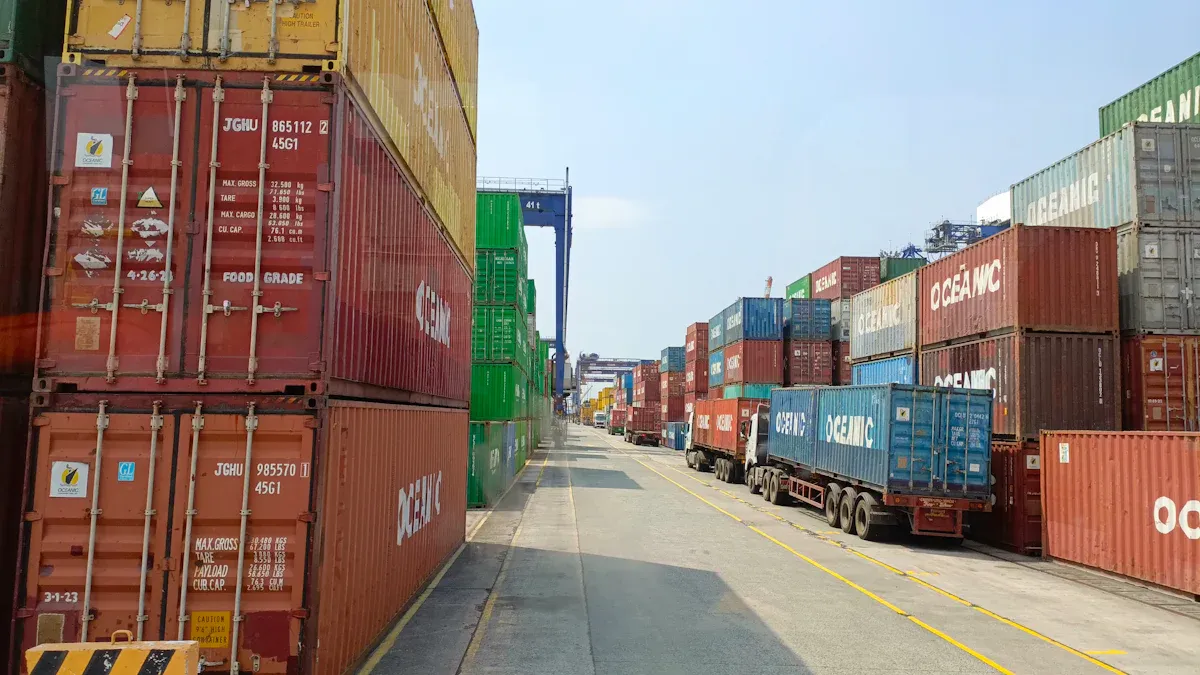
You use yard decking strategy to keep containers moving smoothly. This strategy helps you manage space and stop the yard from getting crowded. When you plan yard decking, you watch how containers move from the ship to the yard. You want to cut out extra moves and keep traffic steady. If you pack the yard too full, RTG movements go up and work slows down. Random stacking can help you use space better and cut down on gantry moves. This makes your yard decking plan stronger and helps you fit more containers.
Here is a table showing best ways to coordinate the yard:
|
Best Practice |
Description |
|---|---|
|
Integration with Existing Systems |
Connect your yard decking plan to WMS, TMS, OMS, ERP for real-time updates. |
|
User-Friendly System |
Train workers and use easy systems so everyone can use them. |
|
Continuous Monitoring |
Use data tools to find problems and make your yard decking better. |
|
KPI Tracking |
Set up KPIs like dwell time, asset turnover, and dock use to check capacity. |
|
Continuous Improvement |
Use feedback and data to improve yard decking and stop delays. |
You check dwell time, asset turnover, dock use, cycle time, throughput, and if carriers are on time. These numbers show how well your yard decking plan works.
Synchronizing crane and yard operations
You match crane and yard work to handle big ships with lots of containers. Yard decking helps you plan ship and yard work to cut down on waiting. You use vessel stowage to get the best crane speed. Yard decking stops you from moving containers around too much. You work with STS cranes to unload and load fast. Teams move containers quickly from the dock to the yard. Careful handling makes gate-in and gate-out smooth. Data from yard decking helps you turn ships around faster and save fuel.
|
Impact on Mega-Vessels |
|
|---|---|
|
Berth Planning |
Cuts waiting when ships arrive |
|
Vessel Stowage |
Gets the best crane speed and fits more containers |
|
Yard Strategy |
Stops extra moves of containers |
|
Coordination of STS Cranes |
Makes unloading and loading faster |
|
Synchronized Transport Fleet |
Moves containers from dock to yard quickly |
|
Precision Handling |
Makes gate-in and gate-out easy |
|
Data-Driven Insights |
Turns ships around faster and saves fuel |
Workflow integration readiness
You use yard decking to connect work between the dock and the yard. Automation, like stacking cranes and guided vehicles, means less work by hand. Smart yard planning changes with ship work and truck arrivals, so you use space well. Working closely with carriers and partners helps things run smoothly and cuts delays. Yard decking makes containers move better and lets you fit more in the yard.
If you cut ship turnaround time by 10%, you can move about 8% more containers. Yard decking helps you do this by making work flow better and using space well.
You use CEGC container handling equipment, container gantry crane, and reach stacker forklift to help your yard decking plan. Yard decking gives you the power to match space to ship size and yard needs. You pick yard decking to keep your port working well and ready for big ships.
Monitoring berth productivity metrics
Key performance indicators
You watch key performance indicators to see how well your portal crane works at the berth. These numbers help you know if your portal crane is working as hard as it can. You check berth productivity, yard use, gate moves each hour, equipment use rate, dwell time, on-time arrivals and departures, cargo damage rate, and customer satisfaction index. Each number shows how your portal crane moves containers and uses its power. You use these numbers to find ways to make your portal crane work better and handle more containers.
You need to keep an eye on cycle time, idle time, and throughput. These numbers show how your portal crane uses its power and how fast it moves containers.
Here is a table with goals for top-performing terminals:
|
Metric |
Benchmark Value |
|---|---|
|
Turnaround Time (TAT) |
Less than 24 hours for big cargo ships |
|
Berth Productivity |
|
|
Equipment Utilization |
Around 70-80% |
|
Idle Equipment |
0.91% of average time in order control |
Real-time data and analytics
You use real-time data and analytics to make smarter choices about your portal crane. Data visualization lets you see how your portal crane uses its power every hour. Fast insights help you change your portal crane’s speed and power to match what is needed. You use CEGC’s analytics tools to watch portal crane performance and power. You check cycle time and throughput to keep your portal crane working at its best. You see how automation and smart systems help your portal crane use its power better and cut down on idle time.
-
Real-time data helps you use portal crane resources in the best way.
-
You use analytics to make portal crane fleet work better and handle more.
-
You make smart choices about portal crane schedules and power.
Continuous improvement feedback
You use feedback loops to make your portal crane tactics better and boost power. Regular meetings help you use feedback to make changes in portal crane work. Working with different teams helps you fix problems and raise portal crane power. Feedback all the time gives you quick ideas to make portal crane work better. You set up a feedback plan to keep your portal crane working at full power. Employee feedback loops help your team take charge and find ways to use portal crane power better.
-
Feedback loops give you useful ideas to make portal crane work better.
-
You use many points of view to find and fix portal crane problems.
-
Getting better all the time comes from regular talks and feedback on portal crane power.
Marine durability and lifecycle protection
Anti-corrosion systems
You work in harsh marine weather every day. Salt, water, and dust can damage your portal crane. You need strong anti-corrosion systems to keep it safe. Heavy-duty galvanization helps stop rust from forming. Special anti-seawater grease covers moving parts and blocks rust. Non-rotating and anti-crushing designs help your portal crane stay steady at sea. You follow strict Class Society rules like DNV, ABS, and CCS. These features keep your portal crane safe and working well.
|
Feature |
Description |
|---|---|
|
Material |
Heavy-duty galvanization for enhanced corrosion resistance |
|
Grease |
Specialized anti-seawater grease for superior protection |
|
Design |
Non-rotating and anti-crushing structures for marine stability |
|
Compliance |
Meets rigorous Class Society standards for reliability |
Structural fatigue design
You want your portal crane to last a long time. Structural fatigue can make it weaker and less safe. A 4-chord boom gives your portal crane more strength. This design helps it handle sideways pulls and last longer. Custom features like rail spacing, portal height, and wheel loads make it stronger. Pull cylinders stop crashes with swinging loads and protect piston rods. Strong paint with many layers protects your portal crane from bad weather. Round tower shapes spread out force and stop twisting damage. These features help your portal crane stay strong and safe.
|
Design Feature |
Description |
|---|---|
|
4-chord boom |
Maximum stability and extended service life |
|
Customized portal |
Tailored rail spacing, height, and wheel loads for structural integrity |
|
Pull cylinder |
Prevents collisions and protects piston rod |
|
Robust paintwork |
Multiple coats withstand harsh maritime conditions |
|
Round tower design |
Even force distribution increases service life |
Serviceability and maintenance
You keep your portal crane working by checking it often. You inspect lifting equipment to keep it safe and strong. Smart control systems help you work safely and with more accuracy. Variable frequency speed control saves energy and lowers costs. You pick modular access so repairs are quick and easy. CEGC gives you maintenance plans and lets you choose anti-corrosion levels. You match your portal crane’s power and safety to your project. You keep your portal crane ready for every job.
-
Regular checks keep your portal crane safe and working well.
-
Smart control systems help you work safer and better.
-
Variable speed control saves energy and money.
You protect your portal crane from rust, damage, and high costs. You pick CEGC for custom plans and care that fit your needs.
Predictive maintenance and energy efficiency
Condition monitoring
You want your portal crane to work all the time. Condition monitoring helps you find problems early. You use smart monitoring to check your portal crane every day. IoT remote monitoring shows you load and maintenance needs right away. Online monitoring helps you spot trouble and plan repairs. You get alerts when something is wrong, so you can fix it fast. Vibration data helps you plan when to do repairs. You can watch many portal cranes at once, even from far away. This keeps your team safe and your work smooth.
-
Smart monitoring shows you what is happening right now.
-
IoT remote monitoring checks load and maintenance needs.
-
Online monitoring finds problems early.
-
Alerts warn you before something breaks.
-
Vibration data helps you plan repairs.
-
You can track all your portal cranes at once.
Energy optimization options
You save money and make things safer with energy options for your portal crane. Precision motion control gives you many speed choices and flexible power. Good seals and strong materials help your portal crane last in bad weather. You can use different motors and negative brakes for more safety.
|
Strategy |
Description |
|---|---|
|
Precision Motion Control |
Many speed choices and flexible power. |
|
Built for Remote Reliability |
Good seals and strong materials for tough places, so you fix less. |
|
Total Flexibility |
Works with many motors and has negative brakes for safety. |
You use less energy and keep your portal crane working well.
Remote diagnostics
You use remote diagnostics to keep your portal crane safe and strong. Real-time monitoring shows you how your portal crane is working. You make smart choices about repairs and keep your portal crane running. Predictive tools help you find problems before they stop your work. You use data to plan repairs and avoid delays. Remote diagnostics let you check your portal crane from anywhere. You always know your portal crane is safe and ready. This keeps your team safe and your port working.
You get better safety, less downtime, and more reliability when you use predictive maintenance and remote diagnostics with your portal crane.
You make berth work better by using advanced portal crane tactics and smart yard decking. CEGC gives you standard and custom port machines for any project.
|
Benefit |
Result |
|---|---|
|
Improved productivity |
Operations are faster, safer, and smoother |
|
Lower idle time |
Equipment is used more efficiently |
|
Higher schedule reliability |
Customers are happier with the schedule |
Use these strategies to get better results and safer port work.
FAQ
What is a portal crane used for at a port?
You use a portal crane to lift and move containers between ships and the dock. It helps you speed up loading and unloading.
How do anti-sway systems help you?
Anti-sway systems keep loads steady. You get safer lifts and faster moves. Your team works with less risk and more accuracy.
Can you customize CEGC portal cranes for your project?
Yes. You choose capacity, height, power, and automation. CEGC matches your portal crane to your port’s needs.


