
You deal with many dangers when working at ports. Container crane remote monitoring improves safety compliance and helps keep you safe. It lowers risks like cargo crushing, collisions, and falling.
|
Safety Challenge |
Automated Solution |
|---|---|
|
Cargo crushing |
Automated lifting and remote control keep workers safer. |
|
Collision |
Automated stackers stop unsafe moves. |
|
Fall from height |
Remote control keeps you away from dangerous spots. |
Advanced tools like anti-sway and predictive maintenance help you stay safe and work better. CEGC provides container handling equipment that meets safety rules.
Key Takeaways
-
Container crane remote monitoring lowers safety risks a lot. It helps stop cargo crushing and collisions. Operators can control cranes from far away. This keeps them safe.
-
Real-time data and alerts let operators see dangers early. This helps them follow safety rules. It also stops accidents before they happen.
-
Predictive maintenance with remote monitoring cuts down on downtime. It also lowers repair costs. This makes work faster and keeps people safer.
Container crane remote monitoring improves safety compliance
Addressing safety risks and compliance challenges
Working with container cranes can be dangerous. You might face crushing hazards, falling containers, and blind spots. Hazardous materials and wrong container placement can cause accidents. Trucks moving near cranes also make things risky.
|
Safety Risk |
Description |
|---|---|
|
Crushing Hazards |
Workers can get hurt if caught between moving containers and objects. |
|
Falling Containers |
If containers are not stacked right, they can fall and hurt people. |
|
Blind Spots and Communication Gaps |
Not seeing everything or talking poorly can cause deadly accidents. |
|
Handling Hazardous Materials |
Spills or mistakes with dangerous materials can harm your health. |
|
Incorrect Container Placement |
Putting containers in the wrong place can cause crashes and injuries. Monitoring helps stop this. |
|
Risks from External Trucks |
Trucks near cranes add more risks. Monitoring helps keep you safe. |
Container crane remote monitoring helps you spot dangers early. New crane control systems let you see what is happening around the crane. You can control cranes from far away, so you stay out of dangerous places. This lowers your chance of getting hurt and makes it easier to follow safety rules.
Technical solutions: anti-sway, interlocks, and operator support
Modern crane control systems use smart technology to keep you safe. Anti-sway control lets you move containers smoothly, even when it is windy. Sensors and controllers check and fix the crane’s movements. Safe load indicators tell you if the crane is lifting too much or swinging too much. These features help you avoid accidents and keep the crane steady.
|
Component |
Description |
|---|---|
|
Sensors |
Sensors measure swing angle, speed, and position. |
|
Controllers |
Controllers use smart algorithms to fix problems. |
|
Actuators |
Crane motors change speed to stop load sway. |
|
Hoist-based Control |
Hoist motors change rope length to fix vertical sway. |
|
Trolley-based Control |
Trolley moves sideways to fix lateral sway. |
|
Combined Control |
Both hoist and trolley work together for tough sway. |
|
Key Technologies |
Laser range finders and sensors help detect problems. |
|
Control Algorithms |
Smart algorithms make the system work better and safer. |
|
Human-Machine Interfaces |
Modern screens show sway and system status. Operators can step in. |
Safety interlocks use limit switches, overload protection, and emergency stops to prevent unsafe moves. Anti-collision technology stops the crane if it gets too close to something. Safe load indicators warn you before trouble happens, so you can act fast.
Modern crane control systems help operators with easy-to-use controls. You get custom controls, comfy designs, and camera views to see better. You can work from remote stations, which keeps you comfortable and focused. These features help you make good choices and avoid mistakes.
-
Automation cuts down on human mistakes.
-
Anti-collision systems stop accidents.
-
Traffic monitoring helps you avoid jams.
-
Data analytics give you tips to work better.
-
Smart add-ons and comfy designs make your job easier.
-
Custom controls fit what you need.
Using container crane remote monitoring lowers safety incidents a lot. Many ports see a 40% drop in driver safety incidents after using these systems. Safe load indicators and smart analytics help you spot risks before accidents happen.
Real-time data and early hazard detection
Real-time monitoring is important for crane control systems. You get instant data about crane operations, which helps you find hazards early. Safe load indicators and sensors track weight, angle, and position for every lift. If something is wrong, the system alerts you right away.
Industrial load monitoring systems warn you early. They check many things at once, so you can spot problems before accidents happen. Automated systems watch for strange activity and help you act fast. This keeps you and your team safe.
Remote monitoring also helps you follow safety rules. You get alerts in real time to stop overloads and other dangers. Watching key things like boom angle and slew position helps you follow safety regulations. You can fix problems before they get worse, which lowers equipment failure.
Modern crane control systems give you better visibility than old methods. You do not need ground observers or fixed cameras anymore. You use real-time data and smart alerts to keep your work safe. Container crane remote monitoring makes it easier to spot and fix problems before they cause accidents.
Tip: Check the dashboard for safe load indicators and system status before each shift. This helps you find issues early and keeps your team safe.
Container crane remote monitoring gives you tools and information to work safely. You get better visibility, faster alerts, and more control over your equipment. These benefits help you cut accidents, follow safety rules, and keep your port running well.
Operational and business benefits for port operators
Reduced downtime and predictive maintenance
You want your cranes to work without stopping often. Remote monitoring helps you find problems early. Predictive maintenance uses real-time data to check for signs of wear. It looks at vibration, temperature, and other clues. You can fix issues before they cause breakdowns. This means less downtime and lower repair costs.
-
You do maintenance when the data says it is needed. You do not follow a set schedule. This saves labor and cuts spare part costs.
-
Early warnings help you stop big failures. Your cranes last longer and work better.
-
Fewer breakdowns mean fewer accidents and less cargo damage. Automated reports help you follow safety rules.
Remote monitoring keeps your team safer. Workers do not need to climb cranes as much for inspections.
Enhanced productivity and throughput
Remote monitoring lets you see every part of crane operations. You get real-time data about machine health and performance. This information helps you plan better and keep your yard moving.
|
Metric |
Baseline (DSM Port, est.) |
Target (12 months) |
Notes |
|---|---|---|---|
|
28–36 (avg ~32) |
18–22 (avg ~20) |
Automated crane coordination |
|
|
Crane utilization (% time productive) |
65 |
80–85 |
Dynamic slotting |
|
Berth occupancy rate (% slots used) |
78 |
85–90 |
Better sequencing |
|
Unplanned demurrage events (per month) |
3 |
0–1 |
Early warning |
|
Data latency (seconds) |
15–30 |
<2 |
Live feeds |
|
Shipments processed per week |
420 |
510 |
Improved scheduling |
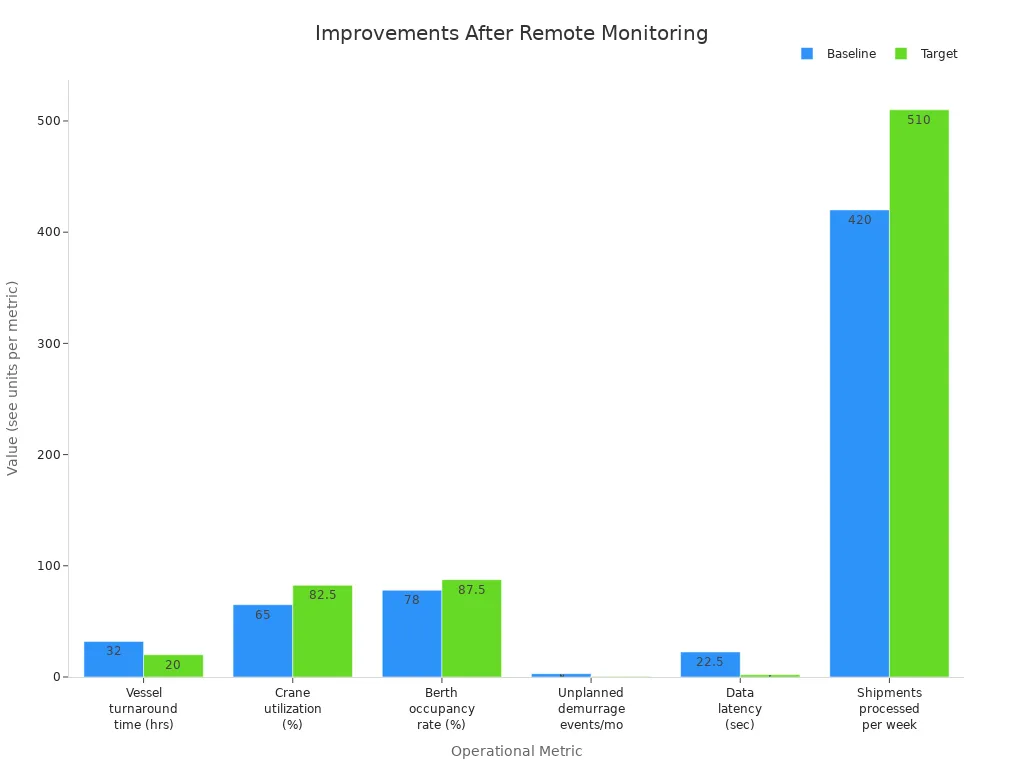
You can spot faults before they stop your work. Predictive maintenance can cut downtime by up to half. Better visibility helps you speed up cycle times. Your port runs faster and smoother.
Customization and integration with CEGC port machinery
Every port is different. CEGC gives you equipment that fits your needs. You pick the right capacity, automation level, and anti-corrosion features. CEGC connects remote monitoring to your workflows. You can track load moment indicators and other key data easily.
-
Real-time access to process information boosts asset productivity.
-
Automation of reporting tasks saves time and reduces errors.
-
You get improved visibility across your entire operation.
With CEGC, you can customize your cranes for your project. This flexibility helps you work safer and more efficiently.
You can make your port safer and work better with container crane remote monitoring. The table below explains how remote operations, AI, and operator jobs help safety and how well things work.
|
Key Insight |
Description |
|---|---|
|
Evolution of Remote Operations |
Terminals now use shared remote operations for more safety and better work. |
|
Role of Remote Operators |
Operators watch over the work and make good choices. |
|
AI Integration |
AI helps keep things safe but needs to be planned and checked. |
Many ports use new tools to stay ahead:
-
Drones check the air for problems.
-
Just-in-Time systems help manage traffic.
-
Port Community Systems keep track of equipment.
-
Blockchain makes deals easier.
CEGC gives you choices that match what you need. You can count on remote monitoring to help your port get ready for what’s next.
FAQ
How does remote monitoring improve crane safety?
You get alerts right away if something is wrong. These alerts warn you about overloads, crashes, or unsafe moves. Remote monitoring helps you see dangers early. This keeps you and your team safe.
Can you customize CEGC container crane monitoring systems?
You can pick how much weight the crane can lift. You also choose how much automation you want. There are anti-corrosion features to help the crane last longer. CEGC lets you change things for your port’s needs.
What data can you track with remote monitoring?
|
Data Type |
Example |
|---|---|
|
Load Weight |
How heavy the container is |
|
Crane Position |
Boom angle or trolley spot |
|
System Health |
Vibration or temperature |


