
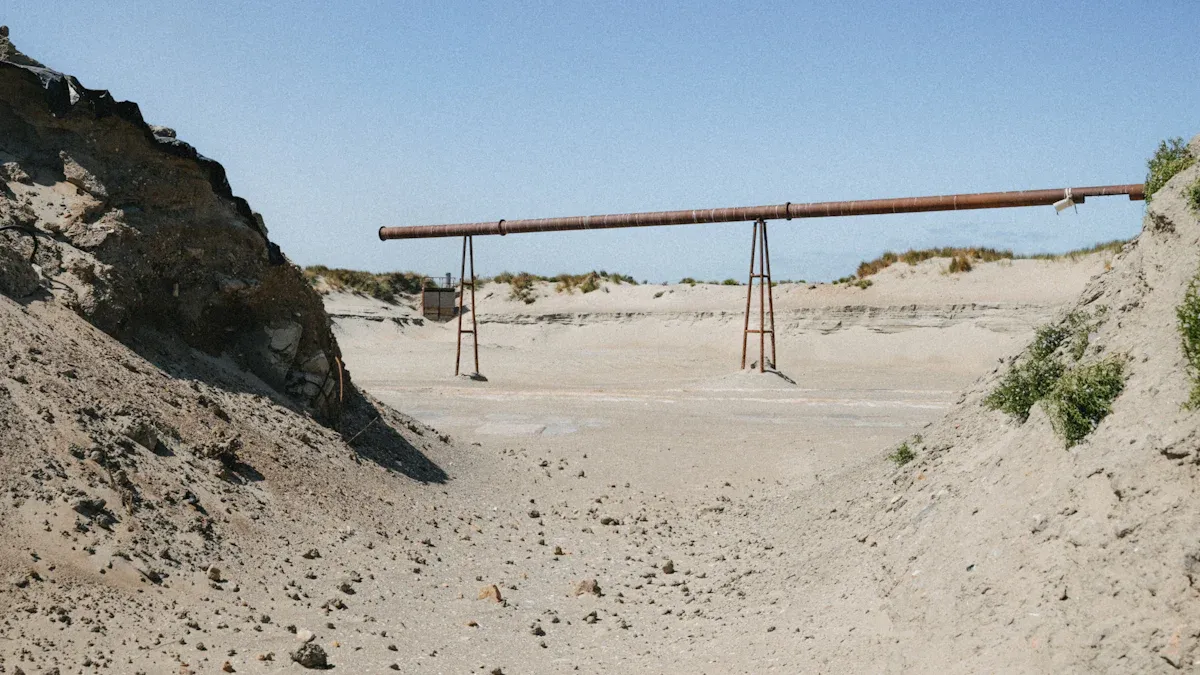
Horizontal directional drilling (HDD) is crucial for modern infrastructure development. The CEGC HDD Drilling Machine Masters Rocky Sandy Terrain, excelling in challenging ground conditions. This machine efficiently drills through tough soil, meeting the growing demand for trenchless technology. The expanding horizontal directional drilling market underscores the importance of directional drilling machine technology.
Key Takeaways
-
CEGC's HDD machines use special tools and strong power. This helps them drill through hard rock and loose sand.
-
Advanced guidance systems and fluid management make drilling precise. They also keep the bore stable.
-
HDD protects nature and workers. It also saves money and time compared to old digging methods.
Challenges of Rocky and Sandy Terrain for HDD
Abrasive and Unstable Sandy Soil
Sandy soil makes horizontal directional drilling hard. Sand feels soft. But it can rub things away. Cody Mecham is a product manager. He says sand wears tools. It wears them as much as hard rock. Special drilling fluids are key. They stop wear on bits, reamers, and rods. Without good grease, sandy dirt causes much wear. Sand is also hard to hold still. It can quickly wear down a drill bit. Bits with carbide cutters are best. They have hard surfaces. Reamers need strong protection. They also need to pump. This mixes sand with fluid. It keeps it flowing. Otherwise, sand settles. This causes more wear. Hard-facing the drill head helps. Other tools also need it. Use tungsten carbide flux. This stops extreme wear. Loose sandy soils cause issues. Holes can fall in. Fluid can be lost. It is hard to stay straight. This happens during drilling. Loose dirt does not support well. This makes building hard. It is tough for HDD users.
Hard and Unpredictable Rocky Formations
Hard rocky ground also makes HDD tough. Rocks like granite are igneous. They form from heat and pressure. Metamorphic rocks have crystals. They are very hard. They are often over 18,000 psi. Softer rocks are easier. Shale or sandstone are examples. But dense rocks are hard. Cobble and glacial till are tough. Rock types are hard to guess. They are natural. Humans cannot control them. This makes drilling very hard. Unknown rock means constant changes. This stops the drill from sticking. It is hard to drill well. Hard and uneven rock can cause mistakes. Keeping steady weight on the bit is key. This helps with steering. Picking the right tools is also vital. It helps with good drilling. The HDD drilling machine masters rocky sandy terrain by changing to these conditions.
Traditional Drilling Limitations
Old drilling ways have limits. This is true in tough ground. Digging open trenches is not good. Not in hard dirt. This includes solid rock. It can be too hard. Or too costly. Old trenching is less useful. This is true in some soils. Especially solid rock. The need for horizontal directional drilling is clear. HDD is a better way. It installs pipes. No long trenches are needed.
Key Technologies for HDD Mastery in Difficult Ground
CEGC's horizontal directional drilling machines fix tough problems. They use special technical ways. These ways help users with common issues. Our HDD rigs are made for hard ground.
Advanced Drill Bits and Reamers
Drilling in hard rock and sand needs special tools. CEGC uses better drill bits and reamers. These tools work in different grounds. They are good in clay, sand, and rock. Polycrystalline Diamond Compacts (PDC) are key. PDC bits use them for wear. This makes them good in hard rock.
Strong carbide makes good DTH hammer bits. The material holds buttons. These buttons take strong hits. They stay put. Special metal work makes them hard. This hardness is between parts. Special heat makes tools last. Surface hardening also helps. Good steel alloys are in the bit. They make tools last longer. They keep them strong.
Button setup and design are important. Side buttons keep the hole size. Front buttons do the main crushing. The pattern changes drill speed. It also affects bit steadiness. Good button layouts balance power and wear. Spacing stops tracking. It helps rock break well. Computer models help design DTH hammer bits. They find the best button spots. CEGC offers tool matching. We also have a strong package. This lowers costs and tool wear.
High-Torque and High-Thrust Rigs
Stuck pipe and stops are big issues. CEGC fixes these with a special engine. It also has safety for too much power. Our rigs have strong turning power. They have many speeds. Hydraulic sensing and pressure control are built-in. Slow start and stop reduce shocks. This saves rods and tools. This is key for steady drilling in hard ground.
For example, different utility directional drill models show varying power.
|
Model |
Thrust/Pullback (lbs) |
Torque (ft-lbs) |
Configuration |
|---|---|---|---|
|
MT13 |
30,500 |
3,700 |
Powerdrill (dirt) |
|
MT18 |
40,000 |
6,050 |
Powerdrill or Rockdrill |
|
MT28 |
60,750 |
8,500 |
Powerdrill or Rockdrill |
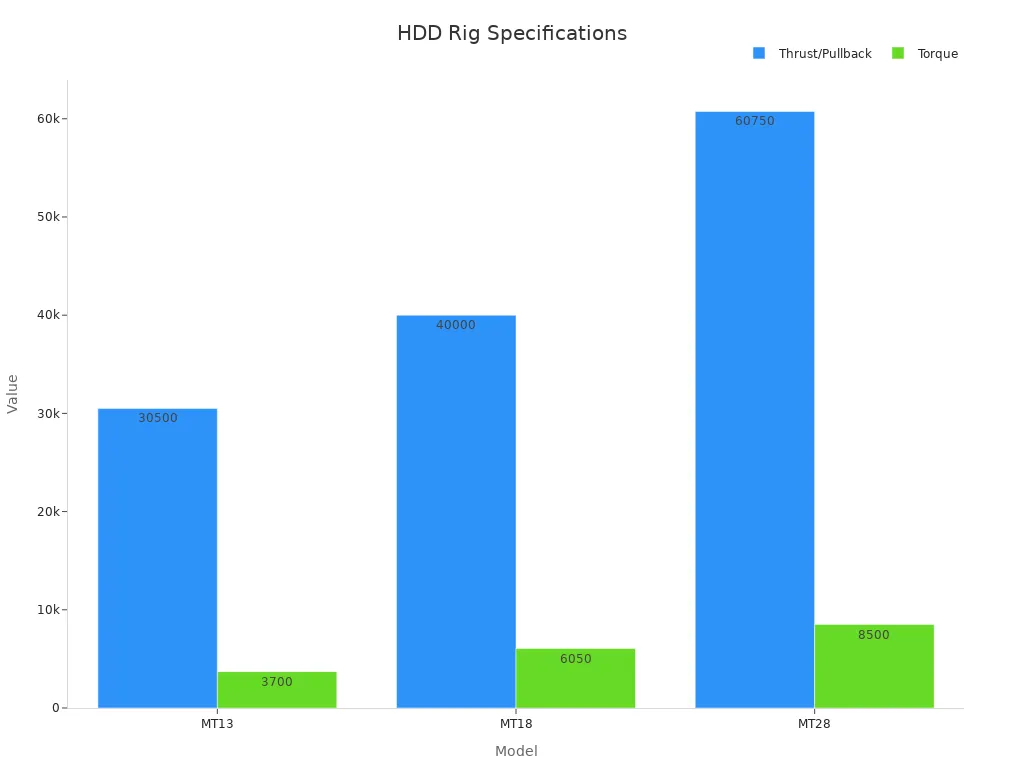
This chart shows power grows with rig size. Our "rock package" is an option. It has special cooling and filters. It has extra turning power. It uses strong parts. This makes the hdd drilling machine masters rocky sandy terrain even better.
Specialized Drilling Fluids
Bad fluid can cause issues. It can lead to frac-out risk. CEGC gives a mud and drilling fluid management plan. This stops low flow or pressure. It lowers stuck pipe risk. It also stops fluid loss. This avoids problems and cleanup. Stable mud keeps the bore steady.
Drilling fluids use special stuff. This helps bores in sandy soil.
|
Additive Type |
Specific Chemical/Example |
Function for Bore Stabilization in Sandy Soil |
|---|---|---|
|
Water/Filtrate Control Additive |
Poly-anionic-cellulose (PACs) |
Seals the wall. It stops water leaks. It controls water. It stops dirt from falling. |
|
Polymers |
Hydrolyzed polyacrylamide (PHPA) |
Stops clay lumps. It works with drilling soaps. |
|
Flocculants |
(Not specified) |
Makes clay particles flow. It stops clay from sticking. |
|
Thinners (Distributors/Deflocculates) |
(Not specified) |
Makes fluid thinner. It stops clay charges. |
|
Base Fluid |
Water |
Main part of drilling fluid. Its pH (8.5-9.5) changes how it works. |
|
Viscosity Agent |
Bentonite |
Makes bore better. It gives 'gel strength'. This holds particles up. It removes cuttings. |
Our plan includes pump size help. This matches flow and pressure. It matches bore length and size. It matches the ground. It also checks circulation and filters. We support good mud rules. This includes mixing goals. It includes checking and changes. This full drilling fluid management helps in all conditions.
Precision Guidance and Tracking Systems
Bore errors and failed crossings are big worries. CEGC offers a precise guidance system. This system stops off-line bores. It makes crossings accurate. These include roads and rivers. Our system uses matched control. It links thrust and rotation. A strong frame reduces shakes. This stops walking. Our system works with tracking. It offers data logging. This advanced steering technology is key for hard jobs.
Precision guidance systems use many sensors.
-
Accelerometers: These are in steering tools. They tell the driller about angle. They also measure angle in downhole tools.
-
Magnetic Sensors: These work with accelerometers. They measure bore direction. They also sense signals from trackers.
-
Gyroscopic Sensors: These are in downhole tools. They measure bore direction. They can replace magnetic sensors.
-
Tracking Technologies: Examples are ParaTrack2 cable. Also Beacon Tracker. And Microcoil. These send signals. Sensors in the tool feel them. This checks positions. It makes things more exact.
-
Inclinometers: They measure pipe angle. This helps steer well.
-
Gyroscopes: They show bit direction. They show rotation. This helps with directional guidance.
-
Magnetic Sensors: They find magnetic fields. This shows pipe position. It helps find it underground.
To make bore path straight, we use many things. It uses INS. It uses acoustic ranging. It uses RMRS. The RMRS system finds signals over 100m. It uses sensitive probes. It uses signal boosters. This makes bore path better. In areas with magnetic noise, INS gives good data. Acoustic ranging helps with position. This allows for exact path fixes. A smart path control system makes it better. It uses real-time drilling data. It uses old data. It guesses and fixes bit path errors. It uses a learning model. This system also sets drilling numbers. It bases this on ground type. It also looks at gas patterns. This makes fixes more exact. This advanced steering technology makes the horizontal directional drill very good.
During drilling, steady path is key. Directional control stays good. Speed is between 0.8–1.2 m/min. Torque stays between 750–950 N·m. This stops too much stress. It also stops bore problems. The RMRS system uses a strong magnet. This is in the target bore. It makes a steady magnetic signal. Probes in the actual bore find the distance. This is between the bit and target. This gives real-time data. It gives closed control. This makes 'point-to-point' exact. Guide holes increase in noisy areas. Spacing goes from 100–50 m. This makes real-time checks better. The BGS system is very exact. It gets about 97% accuracy. This is for the final bore spot. This is true even with small errors. This system also guesses ground well. It guesses bore quality after drilling. This makes directional drilling very trusted.
Operational Techniques for Horizontal Directional Drilling
This part shows how a horizontal directional drill works. It works in tough ground. It gives practical ways to use it.
Pilot Bore Strategies
Starting a bore right is key. Pilot borings help in hard soils. They check drilling methods. They check casing needs. This pre-drilling data helps big jobs. It lowers risks of bore collapse. It also lowers misalignment. ACI 336.3R gives this advice.
To stop bore collapse, take steps. First, check the ground well. Drilling fluid management is important. Watch things all the time. Grouting the pilot hole can help. Casings keep the hole open. These steps make pilot hole drilling safe. They make it work.
Pre-Reaming and Back-Reaming Processes
After the pilot bore, make the hole bigger. Pre-reaming makes the pilot hole larger. It gets it ready for the pipe. Slurry goes into the hole. This happens during pre-reaming. It keeps the hole strong. It also cleans out dirt. This is key for good work.
Pre-reaming makes the pilot hole bigger. It does this slowly. It makes a strong, clean bore. The bore is the right size. This means less rubbing. It makes pipe pullback smooth. Drilling fluid moves during pre-reaming. It helps break soil. It holds dirt up. It moves dirt out of the hole. This keeps the bore strong. Many reaming operations are often needed. This is for bigger pipes. It is also for tough ground. It makes the bore bigger slowly. It stays strong.
Reamers are key tools. They make the pilot hole bigger. They grind soil and rock. Picking the right reamers is very important. Barrel reamers work for sticky soils. Rock reamers work for rough ground. Paddle reamers work for sticky clays. The right reamer makes a strong hole. It is also the right size. Good reamer choice means less rubbing. This is during pipe pullback procedures. This helps with good work. GreatDrillbit's rock reamers work for many types of ground. These include sandstone, limestone, cobble, or mixed ground. GreatDrillbit gives good advice. They help choose the right hdd hole opener. This depends on the ground. It depends on the utility directional drill setup.
Managing Fluid Pressure and Returns
Controlling drilling fluid pressure is very important. It stops frac-outs. Frac-outs happen when fluid goes into cracks. Many ways help manage this.
-
Diagnostic Fracture Injection Tests (DFITs): These tests use a little fluid. It goes in slowly. This gives pressure data. It helps guess the fracture gradient. It also finds the best pressure.
-
Geomechanical Modeling: Computer models show how rock acts. They show how it acts under stress. They guess pressure needed to start cracks. They guess pressure to spread them.
-
Real-Time Monitoring: This is key during work. It keeps pressure safe. It allows for changes. This is based on live info.
Other ways also help.
-
Automated Pressure Control Systems: These use sensors and computers. They watch pressure. They change it in real-time. This keeps it safe and good.
-
Enhanced Fluid Formulations: Better fracturing fluids help. They make fracturing better. This happens at lower pressures. It makes cracks spread better. It also harms nature less.
-
Data Analytics and Machine Learning: Computers guess pressure needs better. They use old and live data. This makes pressure settings better. This is for specific jobs.
Drilling fluid management also uses special ways.
-
Experimental device by Sui et al.: This device shows fluid loss. It also shows plugging of drilling fluid. It works under real stress. This shows how cracked ground acts.
-
Prediction method by Bai et al.: This method guesses drilling fluid loss well. It works in cracked ground. It figures out crack width. It measures fluid thickness. It also measures flow and yield stress.
-
Monitoring system by Jiang et al.: This system watches drilling fluid loss. It uses fiber optic sensors. It measures loss points. It also checks loss strength. This helps design ways to stop fluid loss.
Safety protocols are also important. This is for fluid pressure.
-
Geotechnical Investigation: Do good checks. Use good methods. Get detailed soil info.
-
Correct Drilling Fluid Mix Design: Make sure the drilling fluid mix is right. It needs good gel strength. It needs good plastic thickness. It needs a good yield point.
-
Frac-out Risk Assessment: Use data from soil reports. Use software or pressure math. Compare max allowed fluid pressure. Compare it to expected drilling fluid pressure.
-
Continuous Monitoring of Drilling Fluid Parameters: Watch circulation pressure often. Check gel strength, mud weight, and thickness.
Managing fluid returns is also part of drilling fluid management. It makes sure nature rules are met. It also makes work good. Proper haul-off and disposal of fluids. And drill cuttings are very important. This stops nature problems. It stops risks. A full fluid management program includes these services.
Popular disposal methods include:
-
Land farms: Cuttings and mud go into soil. This happens on a licensed place. It uses thinning, natural breakdown, and soaking up. Land farms must be far from homes. Far from nature. Far from groundwater.
-
Injection: Cuttings are ground into tiny bits. They mix into a slurry. Then they go into a permitted well or cave. This makes sure local groundwater is not touched. Other methods are natural breakdown. Burning. And making solid. Moving cuttings and liquids needs thought. Think about the closest disposal site. Think about road conditions. And the route. Look at trucking and disposal costs. Think about the type of truck. This can be open, covered, or sealed. Rules like permits and reports are also key. All work must be safe. And responsible.
A drilling fluids engineer manages fluid returns. They make daily mud reports. They talk to the solids control expert. This keeps solids control working. They change the fluid plan. This is if things go wrong. This keeps the fluid system working well. They check mud weight and thickness often. They combine drilling data. This includes well depth. Bit size. And pump data. They also combine mud properties. This includes weight. pH. Thickness. And solids. They put this into daily reports. They add chemicals. This is to change mud properties. This happens when ground issues appear. These issues show in flow. Cuttings. Or returns. They might show gas or saltwater. They do retort tests. This finds the solid percentage. They send mud to labs. This is for particle size checks. This helps adjust thinning. They watch and adjust screen size. This removes most cuttings. It lets fluid through. They talk to solids control experts. This ensures good removal of light solids. They keep desired drilling fluid properties. They add chemicals when mud weight goes up. They adjust solids control gear. This includes screens. And centrifuge speeds. This makes work cost-effective. They keep mud properties. They add thinning volume. This controls solids. It keeps volume as new hole is drilled. This makes the hole strong. It keeps the mud system steady. They watch the mud system 24/7. They take samples for solids. They check underflow and overflow. They do upkeep. Like shaker screen repair. They work closely with the solids control expert. They also work with the drilling team. This fine-tunes the system. It gets maximum cuttings removal. It reconditions fluid. It reclaims barite. Diesel. And other elements. It does this with minimal thinning.
Mitigating Environmental Impact
Horizontal directional drilling greatly reduces harm to nature. It needs only small access pits. This saves landscapes. It stops erosion. Its closed-loop drilling fluid systems stop groundwater pollution. This is a big plus. It helps in sensitive areas. These include riverbanks. Or protected forests. Trenchless methods like hdd use fewer heavy machines. They also have shorter project times. This means less carbon. It means less energy use. This is compared to digging open trenches.
HDD means less need for open trenches. Trenches can disturb nature. They can harm waterways. And wetlands. By limiting surface impact, hdd helps save natural homes. It also reduces soil erosion. HDD is less invasive. It avoids sensitive areas. These include protected forests. They include natural rivers. They include preserved wetlands. They include homes for endangered animals. They include water systems. They include important farm soil. It removes the need for dredging. It avoids disturbing water life. This is common in old open-cut methods. Those methods can stir up bad toxins. They can pollute water downstream. These safety protocols protect the environment. A utility directional drill helps achieve these goals. This horizontal boring method is a good choice. This is for directional projects. It ensures safety for workers. And the environment. These drilling processes are carefully planned.
Good HDD Jobs in Rocky and Sandy Areas
Horizontal directional drilling works well. It works in tough ground. Many jobs show it works.
Pipes Under Rocky Rivers
Putting pipes under rivers is common. Rocky riverbeds make it hard. An horizontal directional drill can lay pipes. It does not bother the water. For example, a job might cross a river. It has granite rock. Special tools are needed. The hdd drilling machine masters rocky sandy terrain here. It makes sure pipes go through safely.
Utility Lines in Deserts
Deserts have sand and hard rock. Putting underground utilities here is hard. HDD is a good way. It puts in lines for power or internet. This avoids digging big ditches. It protects the desert. A utility directional drill can work in these mixed areas. It gives good service. This way protects nature.
What We Learned and Best Ways
Good HDD jobs need good plans. Checking the site well is key. It finds problems. It helps plan for surprises. For example, jobs in Washington had changing ground. It went from soft sand to hard rock. This showed planning must change.
|
Description |
|
|---|---|
|
Full Site Checks |
Detailed ground tests. Mapping utilities. These find problems. They help plan for issues. |
|
Right Tools and Care |
Using the correct tools. Keeping them in good shape. This makes them work best. |
Picking the right tools is also key. Special tools are needed for granite or hard rock. This makes drilling fast. Checking and fixing tools stops them from breaking. Holes can fall in. Fluid can be lost. This is true in gravel. Good ground checks help. They help with design and building. Engineers must tell owners about risks. This helps set contractor rules. It helps contractors plan. This makes sure the right utility directional drill is used. It makes directional drilling safe. It works for underground utilities.
Benefits of HDD in Tough Ground
Less Harm to Nature
Horizontal directional drilling helps nature. It needs small holes. This saves land. It stops dirt from washing away. Its fluid systems stop water pollution. This is good. It helps in special places. Like riverbanks. Or forests. HDD uses fewer big machines. Projects finish faster. This means less carbon. It uses less energy. This is compared to digging. This way keeps nature safe.
Better Safety and Work
HDD makes workers safer. They stay out of deep holes. This means fewer cave-ins. Less traffic danger. Fewer open holes mean fewer risks. Good control of drilling means fewer mistakes. This makes work better. Rules for safety are easier to follow. This makes sites safer. This way also bothers people less.
Cheaper and Faster Work
HDD jobs are often quicker. They cost less. This is compared to old ways. No big holes are needed. Less traffic trouble. This means jobs finish fast. HDD finishes jobs faster. It digs less. It closes roads less. This helps jobs finish fast. Less surface work saves time. New drilling tech makes jobs faster. This makes underground utilities easier. Following safety protocols stops delays.
Many Uses for Projects
HDD is very useful. It can put in many pipes. Like water pipes. Gas lines. Electric wires. It works in different grounds. Like rocky and sandy places. It can go in many directions. It goes under rivers. Roads. Buildings. This makes HDD a top choice. For new projects. It keeps projects safe. It makes them work.
CEGC's HDD drilling machine works well. It works in rocky and sandy ground. This machine is very important. It uses new tech. It uses exact drilling ways. This makes drilling work. Horizontal directional drilling helps a lot. This HDD way does not harm nature much. It makes things safer. It saves money. So, HDD is the best choice. It is good for modern drilling. It keeps things safe in hard drilling.
FAQ
How does sandy soil make HDD drilling difficult?
Sandy soil rubs a lot. It wears out tools fast. It is also not steady. Holes can fall in.
What technologies help CEGC machines drill through hard rock?
CEGC uses better drill bits. They have strong push and twist. Special liquids also break hard rock.
What are the main benefits of using HDD in challenging ground?
HDD harms nature less. It makes workers safer. It also costs less. Projects finish faster.


