
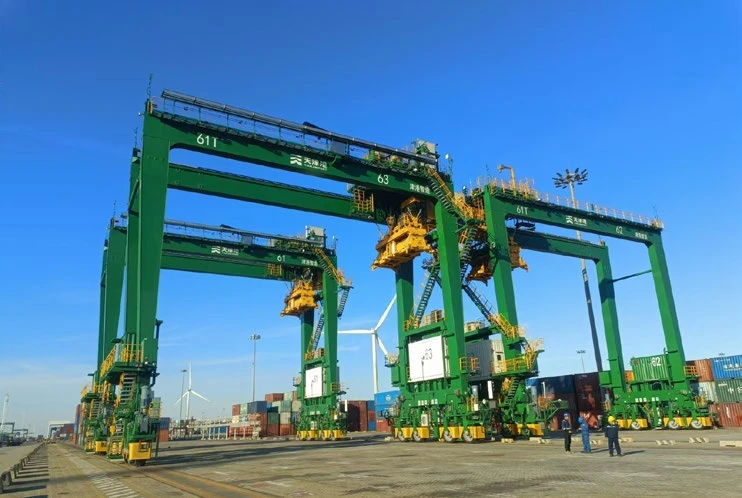
To address the question of "Port crane throughput: how to prove ROI to CFO," you need to analyze operational improvements and present clear cost-saving evidence. CEGC delivers market-standard performance specs and offers project-based customization for portal cranes and container handling equipment, ensuring solutions fit your terminal’s unique needs.
|
Factor |
Impact on Efficiency and Profitability |
|---|---|
|
Modern Container Cranes |
With CEGC’s advanced container cranes, loading or unloading can occur every 90 seconds, significantly boosting port crane throughput and reducing vessel turnaround time. |
|
Dwell Time |
Reducing dwell time to less than 3–4 days optimizes terminal operations and increases overall throughput. |
|
Infrastructure |
Robust infrastructure, supported by CEGC’s container handling equipment, prevents bottlenecks and accelerates cargo movement. |
|
Inter-modality |
Efficient inter-modal solutions from CEGC enable faster cargo transfers, maximizing terminal productivity. |
When presenting to the CFO, you can prove ROI by demonstrating how CEGC’s solutions directly enhance port crane throughput, reduce operational costs, and increase profitability with measurable results.
Key Takeaways
-
Use important numbers like cycle time and moves per hour to check how well the port works. These numbers show how good your port is at doing its job.
-
Put in CEGC's advanced cranes and tools to lower costs and move more cargo. This makes ships leave faster and helps you earn more money.
-
Gather and study data before and after you make changes to show ROI. Use this data to help your CFO trust you and see the value over time.
Port throughput metrics and ROI essentials
Key metrics: cycle time, moves per hour, OEE, TEEP
You can check how well your port works by looking at some important numbers. These numbers show how your portal crane, container crane, or ship loader does during cargo work. The most important numbers are cycle time, moves per hour, OEE, and TEEP. Each one tells you something different about how well your port works.
|
Indicator |
Description |
Calculation |
|---|---|---|
|
Cycle Time |
Time to handle one container (VAN) |
(Tno × 60)/TLC |
|
Moves Per Hour |
Number of containers moved per hour |
60/net cycle time |
|
OEE |
Measures availability, performance, and quality |
(Top/(Tmc - Tps - Tem)) × 100% |
|
TEEP |
Total effective equipment performance |
((Tmc - Tem - Tps)/Tmc) × 100% |
|
MMBF |
Mean movements between failure |
TLC/Fem |
|
MTTR |
Mean time to repair |
Tem/Fem |
You can use these numbers to see how your equipment compares to others. For example, mid-size terminals can do about 35 moves per hour when they are busy. Mega-ship terminals can do up to 50 moves per hour. More moves per hour means your port works better and ships leave faster.
Data collection: before-and-after analysis, benchmarking
To show your CFO the ROI, you need good data. Start by writing down numbers before and after you make changes to your container gantry crane, container handler, or ship crane. This helps you see how the changes make your port better.
You should also compare your port to other ports like yours. Use their numbers to check if your cargo work is as good as theirs. Here is a table that shows how different ports do:
|
Terminal Type |
Average GMPH |
Crane Intensity |
Best Practices Identified |
|---|---|---|---|
|
Small Container Terminals |
Lower |
Fewer quay cranes |
N/A |
|
Mid-size Terminals |
Near 35 |
More cranes, larger yard |
Quay crane scheduling, yard rotation |
|
Mega-ship Terminals |
Up to 50 |
High peaks during calls |
N/A |
You can also use your Terminal Operating System to watch data in real time. This system gives you live updates on how you move containers and cargo. It helps you find problems and fix them fast.
Tip: Use your Terminal Operating System to track dwell time, cargo volume, and vessel turnaround time. This helps you keep your port running well and stop delays.
Impact on cost, revenue, and vessel turnaround
Making your port crane work better helps you make more money. If you lower cycle time and do more moves per hour, your port gets more done. Ships can leave faster, so you can work with more cargo.
-
If you do 10% more moves per hour, ships can leave hours sooner. This lets you help more ships and move more cargo.
-
More moves per hour means you spend less on workers, fuel, and fixing equipment.
-
One company loaded cargo 40% faster after using a 10-ton gantry crane. They could help more customers and make more money.
-
An automotive company saved 20% on energy costs by using an electric gantry crane. This saved them about $3,600 each year.
You can also make your port better by fixing technical problems. Things like load sway, crashes, rust, and downtime slow you down. CEGC has tools like anti-sway control, safety locks, and smart maintenance. These tools help your equipment work safely and smoothly.
-
Anti-sway systems and motion tools stop accidents and make cycle time better.
-
Smart maintenance finds problems early, so you have less downtime and cargo keeps moving.
-
Marine-grade parts keep your cranes safe from rust, so you spend less on repairs and your equipment lasts longer.
When you use these tools, your port numbers get better. Your cargo work is safer, faster, and more steady. You can move more cargo with the same equipment. This makes your ROI higher and your CFO happy.
Proving ROI: financial outcomes and CFO concerns
Calculating ROI: formulas, cost savings, revenue gains
You can show your CFO how port crane throughput helps by using simple math and real numbers. Start with the basic ROI formula:
ROI = (Net Gain from Investment – Cost of Investment) / Cost of Investment × 100%
This formula helps you see how much you save and earn after you upgrade your rmg cranes, container gantry cranes, or ship loader. For example, if you spend $500,000 on automation and anti-corrosion upgrades for your rmg cranes and save $100,000 each year on maintenance and energy, your ROI after five years is:
Net Gain = ($100,000 × 5) – $500,000 = $0
ROI = ($0 / $500,000) × 100% = 0%
If you make more money from faster cycle times and moving more cargo, your net gain goes up. If you earn $200,000 more each year from higher throughput, your net gain is:
Net Gain = ($100,000 + $200,000) × 5 – $500,000 = $1,500,000 – $500,000 = $1,000,000
ROI = ($1,000,000 / $500,000) × 100% = 200%
You can use analytics and data to watch these numbers. Your Terminal Operating System helps you collect live data on moves per hour, vessel turnaround, and energy use. You can check before and after results to prove ROI.
CEGC lets you customize rmg cranes. You can pick ton capacity, span/height, duty cycle, power solution, automation, and anti-corrosion grade. These choices help your cranes fit your yard and how you work. You can choose single or twin-lift cranes, plan for average or busy times, and get ready for busy seasons. Using these features the right way stops problems and saves money.
|
Customization Option |
Impact on Throughput and ROI |
|---|---|
|
Ton Capacity |
Picking the right crane size for your yard stops problems and saves money. |
|
Yard Layout |
Matching cranes to lane widths and stacking height helps things move smoothly and stops slowdowns. |
|
Operational Flow |
Fast crane speed and working with other machines makes everything work better. |
|
Crane Type (Single vs Twin) |
Twin-lift cranes can move more cargo but need good planning to work right. |
|
Average vs Peak Loads |
Choosing cranes for normal loads, not just the biggest, stops wasting money and time. |
|
Seasonal Traffic Variability |
Knowing when you are busiest helps you pick cranes that can handle busy times without being unused later. |
You can use planning and scheduling tools to make crane use better. Automated positioning helps you work faster and move more cargo. Automation cuts labor costs and makes things more reliable, so you spend less fixing things. Anti-corrosion upgrades help cranes last longer and break down less.
Addressing risk, variability, and sustainability
CFOs want to know how you handle risk and changes in port crane throughput investments. You can use risk-adjusted cash flows and capital efficiency plans to show your ideas. You can also work with other teams to check your facts and limits.
|
Methodology/Framework |
Description |
|---|---|
|
Risk-Adjusted Cash Flows |
CFOs want you to use risk-adjusted cash flows and chances in their checks. |
|
Capital Efficiency Framework |
This uses NPV/IRR, payback, and capital per unit to look at investments. |
|
Cross-Functional Engagement |
This means working with different teams to check facts and limits about risk. |
You can use data and planning to watch for changes in how things work. Automated planning and scheduling help you change crane use for busy times and slow times. You can use data to see how things are going and spot problems early.
Long-term value is important for port leaders. You need to think about market risks and what happens if you focus on one thing. If you only work in one market, you could make a lot or lose a lot. Moral hazard risk can happen if people in charge protect workers who do not do well. Financial risks mean you could lose money if the market changes or if it takes a long time to earn back your investment.
-
Market risks can mean big wins or big losses.
-
Moral hazard risk can waste resources.
-
Financial risks mean losing money and waiting a long time to get it back.
You can use automation and planning to lower these risks. Automation cuts labor costs and helps you do more work. Anti-corrosion upgrades cut repair costs and downtime. Energy-saving ways help you spend less. Regular care and smart planning keep your rmg cranes working well.
Presenting data-driven evidence to CFOs
You can show your CFO data by using tables, charts, and reports. You need to show how planning and automation make port crane throughput and ROI better. You can use clear reports to show risks, choices, and what helps you do well. Keeping reports the same helps everyone understand and trust your numbers.
|
Strategy |
Description |
|---|---|
|
Disclosure Excellence |
Give clear, helpful information on risks, choices, and what helps you do well. |
|
Consistency & Comparability |
Make sure all reports match so there are no mixed messages. |
|
Forward-Looking Insight |
Use planning, ROIC/EVA checks, and stories about spending in your reports. |
|
Audit Readiness |
Keep good records and rules so audits go well. |
|
Data Integrity |
Make sure your numbers are right by using good systems and checks. |
You can use your Terminal Operating System to get good data. You can check your numbers and use the same way to report every time. You can use analytics to back up your ideas and be ready for audits.
You can use planning and stories about spending to show what will happen next. You can explain how automation, anti-corrosion upgrades, and faster cycle times will make ROI better over time. You can use data to support your ideas.
Tip: Use planning and data to watch how things go, find risks, and show clear proof to your CFO. This helps you prove ROI for port crane throughput: how to prove roi to cfo and build trust with your finance team.
You can use planning to keep your reports the same and easy to compare. You can use data to show how rmg cranes, automation, and faster cycle times make port crane throughput better: how to prove roi to cfo. You can use automated planning and scheduling to make crane use better and get higher ROI.
You can prove ROI for port crane throughput by using clear metrics and financial data. CEGC gives you technical solutions and custom options for your port.
-
Track your results.
-
Analyze your data.
-
Share your findings with your CFO.
Tip: Keep measuring performance to build trust and show ongoing value.
FAQ
How do you measure port crane throughput?
You check port crane throughput by counting moves each hour. You also look at cycle time and how fast ships leave. Your Terminal Operating System gives you live data to help.
What CEGC features help improve ROI?
You can use anti-sway control and safety interlocks. Marine-grade protection keeps equipment safe. These features help you work faster and safer. They also help you spend less fixing things.
Can automation reduce downtime and energy costs?
Tip: Automation helps you find problems early and save energy. Your cranes work longer, and you pay less for repairs.


