
Portal crane throughput can be significantly improved when you reduce end-stop delays. By focusing on minimizing these delays, you can boost your portal crane throughput and complete more work in less time. Efficient container handling sets your port apart from the competition. CEGC provides solutions that help you operate faster and enhance safety during every lift.
|
Benefit |
Description |
|---|---|
|
RMG cranes from CEGC are designed to maximize portal crane throughput by reducing end-stop delays, allowing you to handle more containers efficiently. |
|
|
Operational Efficiency |
CEGC’s RMG cranes deliver precise movements and heavy-lift capabilities, streamlining loading and unloading operations. |
|
Reduced Idle Time |
Advanced stack management with CEGC equipment means less waiting and more productive work cycles. |
|
24/7 Operations |
CEGC’s RMG technology supports continuous, around-the-clock operations, ensuring ships depart sooner. |
|
Automation Integration |
CEGC RMGs are engineered for compact spaces and seamless integration with automated systems, delivering superior results. |
Key Takeaways
-
Cutting down end-stop delays helps portal cranes work faster, so you can move more containers in less time. - Adding anti-sway controls makes things safer and helps the crane move loads without swinging, which makes the job go faster. - Using real-time data lets you watch what is happening and fix problems quickly, which makes the whole terminal work better.
End-stop delays and port operation inefficiencies
End-stop delays explained
End-stop delays happen when a portal crane or container handler stops at the end of its path. These stops usually take place during loading or unloading at the terminal. Each time the crane stops and starts, the whole process gets slower. To move more containers, you need to cut down on these delays. End-stop delays can make ships and trucks wait longer at the port. This makes it tough to keep your schedule on track and can cause more delays.
Impact on portal crane throughput
End-stop delays slow down portal crane throughput. Reducing these delays helps your terminal work better. If cranes stop often, ships and trucks may have to wait longer. This can mean your team works more hours and costs go up. You might also see traffic jams that slow down your supply chain. These problems make it hard to move lots of containers and can hurt how well your port works. To stay ahead, you should try to lower these delays.
Tip: CEGC gives you standard and custom lifting equipment. This lets you meet your terminal’s needs and handle containers faster.
Causes of delays in container handling
Many things can slow down container handling at your terminal:
-
Traffic problems can delay deliveries, especially in busy cities.
-
Port congestion or strikes can make ships wait to dock.
-
Late cargo production can make you miss your shipping time.
-
Rolled shipments happen when ships are too full, causing more delays.
-
Customs checks and paperwork mistakes can slow down cargo processing.
When you know what causes these delays, you can work to fix them. This helps you improve portal crane throughput by cutting end-stop delays at your terminal.
Solutions for automated positioning and movement
Anti-sway and safe lifting controls
You can make portal crane throughput better by using anti-sway and safe lifting controls. These systems help you move containers more accurately and safely. Anti-sway technology cuts down on time lost from load sway. For example, Danfoss anti-sway systems can make cranes work 10-15% faster. Konecranes Sway Control lets cranes work up to 60% faster than regular cranes. These features give you more control and make lifting safer.
-
Anti-sway controls stop loads from swinging.
-
You get faster cycles because the crane does not wait for swaying to stop.
-
Safe lifting controls help prevent accidents and keep your team safe.
-
These systems lower stress on crane parts, so your equipment lasts longer.
If you add high-speed hoisting mechanisms, you can move containers even faster. This helps you handle more cargo and keeps your terminal running well.
Motion coordination and cycle-time optimization
You can get faster cycle times by using advanced motion coordination. This means cranes, trucks, and other machines work together without waiting. The right system helps you avoid traffic jams and keeps everything moving. Here are some top motion coordination systems and what they do for your terminal:
|
Motion Coordination System |
Description |
Impact on Cycle Times |
|---|---|---|
|
Collaborative Scheduling |
Quay cranes and AGVs work together |
Better operational efficiency |
|
Speed Control Strategies |
AGV speeds change as needed |
Less waiting and idle time |
|
Multi-AGV Collision Avoidance |
Stops AGV crashes |
More reliable operations |
|
Online Preference Learning |
Scheduling changes for new conditions |
Handles real-time changes |
|
Speed Optimization Model |
Truck platooning saves energy |
Faster arrivals and less energy used |
|
Path-Speed Optimization |
AGVs avoid intersection jams |
No congestion at busy spots |
|
Parking Strategy |
Solves AGV path conflicts |
Smoother scheduling |
Cycle-time optimization technology also helps portal crane throughput by reducing end-stop delays. Better scheduling can make productivity go up by 6%. When you make operations smoother, you cut down on congestion and keep your terminal efficient.
|
Feature |
Impact on Throughput |
|---|---|
|
Improved Scheduling Efficiency |
Productivity goes up by 6% |
|
Enhanced Operational Flow |
Fewer slowdowns and less congestion |
High-speed hoisting mechanisms and smart container recognition help you reach these goals. You can move containers quickly and place them exactly where they need to go.
Real-time data and workflow integration
Real-time data integration gives you a clear view of your terminal. You can see what is happening all the time and make quick changes. This helps you spot problems early and fix them before they cause delays. Here is how real-time data and workflow integration help your terminal:
|
Benefit |
Description |
|---|---|
|
Real-time monitoring |
Watch crane operations and adjust right away |
|
Data-driven insights |
Use information to plan and coordinate better |
|
Increased efficiency |
Cut waiting times by optimizing moves with live data |
|
Early problem detection |
Find and solve issues before they slow you down |
Workflow integration with your terminal operating system makes your work even smoother:
|
Evidence Description |
Explanation |
|---|---|
|
Integrated TOS platforms cut out repeated work and remove tasks that do not add value. |
This makes operations smoother and helps cranes work better by cutting out extra steps. |
|
TOS software coordinates equipment use across terminal operations. |
This makes sure cranes are sent out efficiently, improving workflow and cutting idle time. |
|
The system creates reports on terminal efficiency. |
Operators can find problems and change operations, leading to better resource management. |
|
Cargo tracking shows where containers are right away. |
This replaces manual searches, so you can find containers faster and cut delays in crane operations. |
You can also use automated planning and scheduling to use resources better. Automated berth scheduling and yard optimization help you pick the right storage spots and speed up truck processing. These advanced automation features support smart container recognition and keep your terminal running fast.
Case study: reducing delays with CEGC container handling equipment
Many ports have seen big improvements after using CEGC container handling equipment. One terminal cut gate lines and reduced congestion by using automation and smart systems. Terminal efficiency went up, and operations flowed better.
|
Benefit |
Outcome Description |
|---|---|
|
Trucks move faster, less waiting at the gate |
|
|
Reduces congestion |
Operations flow better inside the terminal |
|
Boosts terminal efficiency |
Automation and smart systems improve handling |
CEGC solutions brought strong results:
|
Benefit |
Percentage Improvement |
|---|---|
|
Reduction in manual scheduling effort |
Up to 90% |
|
Faster truck turnaround times |
Up to 50% |
|
Lower detention fees |
Up to 65% |
|
Increase in dock throughput |
Up to 20% |
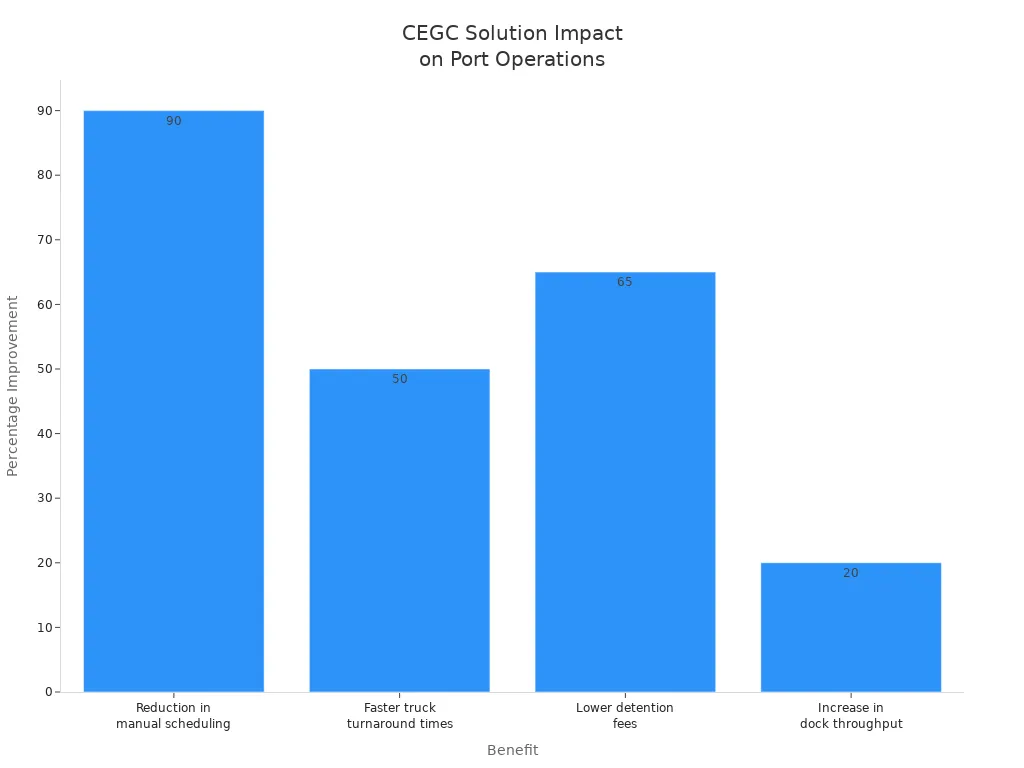
You can see how automated positioning and movement, smart container recognition, and automated planning and scheduling work together to deliver faster cycle times. These tools help you use resources well and keep your terminal ahead of others.
You can make portal crane throughput better with smart ideas. Automation and real-time data help you move cargo quicker. Anti-sway controls keep cargo steady and safe. CEGC cranes can be changed to fit different cargo sizes. Better cargo handling equipment makes things safer and cuts down on delays. Look at the table below to see the main benefits:
|
Benefit |
Description |
|---|---|
|
Enhanced Productivity |
Custom cranes help you move more cargo and stop traffic jams. |
|
Reduced Delays |
Good strategies make cargo wait less and help your terminal work better. |
|
Improved Safety |
Anti-sway control keeps cargo from moving too much and saves money on repairs. |
Check how your terminal works and pick CEGC solutions to move cargo well. Begin making your cargo handling better today.
FAQ
What is an end-stop delay in portal crane operations?
End-stop delays happen when the crane stops at the end. These stops make moving containers slower and throughput goes down.
How does anti-sway control improve safety?
Anti-sway control keeps loads from swinging. This helps stop accidents and keeps your team safe. The crane moves containers more exactly.
Can CEGC customize container handling equipment for my terminal?
|
Customization Option |
Benefit |
|---|---|
|
Capacity |
Handles your cargo amount |
|
Span/Height |
Fits your terminal size |
|
Automation Level |
Works with your workflow |


